CONSTRUCTION
On 28 September, a 22-year-old worker fell to his death from the 12th storey of a Tanjong Rhu BTO worksite while casting concrete with a mobile pump. HDB halted every operation on the project within minutes. Singapore’s own safety regulator has a name for the textbook failure behind most falls like this — and it has nothing to do with a missing harness.
A Project Stops Over One Fall
At around 4:15pm on 28 September 2026, a 22-year-old worker fell from the 12th storey of the Tanjong Rhu Riverfront II Build-To-Order site while carrying out concrete casting work with co-workers, using a mobile concrete pump. SCDF was alerted five minutes later; a paramedic pronounced him dead at the scene. HDB suspended all works on the project immediately and is working with the contractor, BHCC Construction, and the authorities on the investigation. MOM’s response named the baseline requirements that apply regardless of what the inquiry finds: concrete casting equipment must be inspected before use, work must be properly supervised, and measures must be taken to prevent falls when working at height. Whether each of those held on the day is still being determined — but the fact that an entire BTO project can stop over a single fall tells you how little margin this kind of work actually has.
Falls Are Singapore’s Oldest, Least-Solved Safety Problem
The Workplace Safety and Health Council doesn’t bury this statistic: falls from height are the single largest contributor to workplace deaths in Singapore, accounting for more than a third of fatalities in a typical year, concentrated in construction but also showing up wherever workers use ladders or roofs in other industries. That’s not a new trend driven by this year’s headlines — it’s the structural problem the WSH (Work at Heights) Regulations and the Code of Practice for Working Safely at Heights were written to solve, and it persists even in a year when MOM’s mid-2026 report showed the overall major injury rate falling to a record low. Vehicular incidents drove most of this year’s fatality count nationally, but falls remain the category that never leaves the top of the list, which is exactly why a single incident at one BTO site triggers a project-wide stop rather than a localised one.
What “No Proper Barricade” Actually Means at the Point of Risk
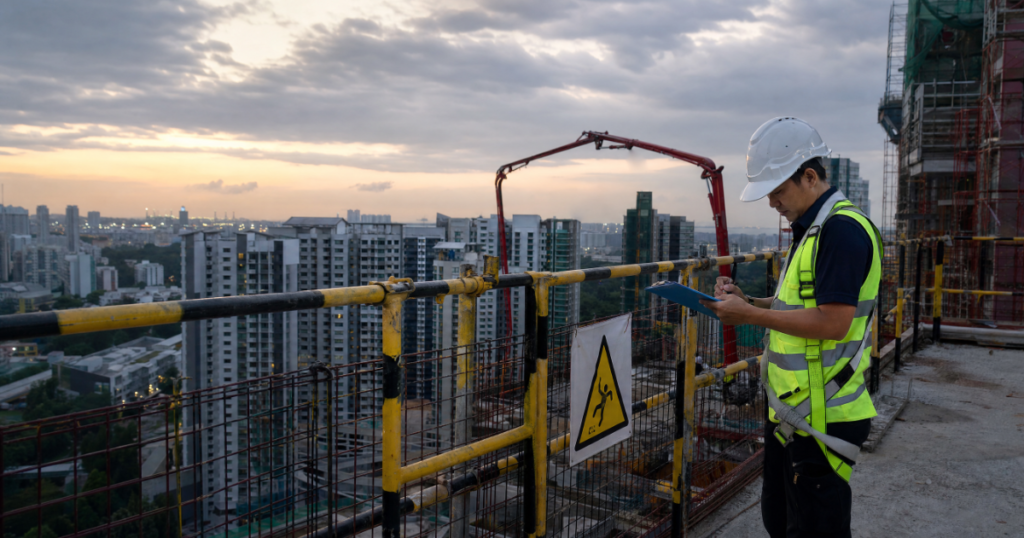
When the WSH Council illustrates what an unsafe elevated workplace looks like, its example is specific: an open building edge without proper barricade. That’s the plainest possible description of the gap between a written fall prevention plan and what a worker standing at a 12th-storey pour actually sees. A mobile concrete pump working an open floor edge needs more than a method statement filed before the shift — it needs a physical barricade at the edge itself, a “Danger — Fall Hazard” warning sign positioned where a worker would otherwise step past it, and an “Authorised Personnel Only” sign controlling who enters the pour zone at all. None of this is exotic signage. It’s the same SS 508 and ISO 7010 vocabulary used on sites across the island — but its value depends entirely on whether it’s physically mounted at the opening on the day, not referenced in a folder in the site office.
The Regulations Don’t Wait for an Investigation to Conclude
MOM’s statement after the Tanjong Rhu fall reads like a checklist precisely because it is one: equipment inspected, work supervised, falls prevented. Every one of those obligations already exists in the WSH (Work at Heights) Regulations, independent of whatever this specific investigation eventually finds. For a site running elevated pours or any work near an open edge, the practical version of that checklist is narrow and repeatable — refresh the risk assessment for every new elevated task rather than reusing last month’s, have a named person check that edge-protection signage and barricade tape are physically in place before each shift starts rather than assuming yesterday’s setup held, and make sure the signage at height-work access points is legible from the ground, not just present somewhere on site. A fall prevention plan that exists only on paper protects a company in an audit. A barricade and a warning sign mounted at the actual edge are what protect the worker standing there.
The Bottom Line
A stopped BTO project and a 22-year-old’s death are the cost of finding out, after the fact, whether an edge was properly barricaded and signed. Singapore’s own safety regulator has been naming this exact failure mode for years — not a shortage of regulation, but a gap between what’s written and what’s visibly mounted at the point of risk. Closing that gap costs a fraction of a Stop-Work Order, and far less than what this month already cost one site. Browse our full range of SS 508-compliant safety signs at safetysigns.sg, including fall-hazard warning signage, barricade tape and authorised-access signs built for work-at-height sites.
Author: safetysigns.sg Team
Date: 8 October 2026