WORKPLACE SAFETY
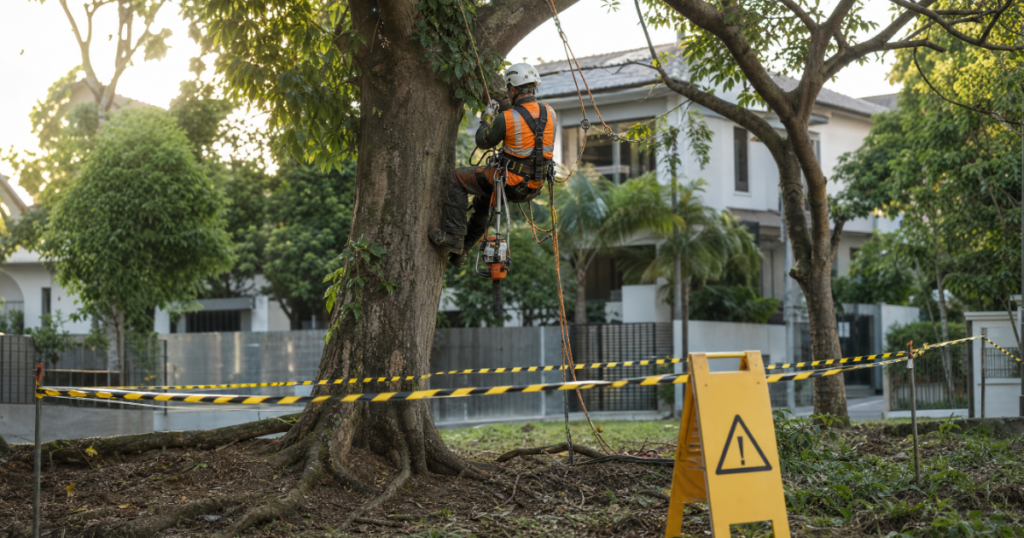
On 13 October 2026, a 38-year-old tree climber fell to his death along with the tree he was felling, on a private property on Cranborne Road in Katong. He was wearing a safety harness. What the job site didn’t have — and what the law doesn’t clearly ask for on jobs like his — was a marked, cordoned danger zone: the kind of exclusion-zone signage that’s second nature on a construction site and almost nonexistent on a residential street.
What Happened on Cranborne Road
At about 2.35pm on 13 October, the tree he was felling toppled at its base, and he fell with it. The Singapore Civil Defence Force and police were alerted; he was taken unconscious to Tan Tock Seng Hospital, where he later died. The company named by the Ministry of Manpower, Soh & Tan Enterprises, said he had worked there “a few years” as a tree climber responsible for pruning and cutting, and that he was wearing a harness during the operation. MOM has ordered the company to halt all tree-felling work involving tree climbing until investigations are complete; police say preliminary findings do not suggest foul play. MOM’s own reminder to the trade afterwards was pointed: assess the tree and the work method before felling, and use trained workers who follow established procedures.
A Worksite the WSH Act Doesn’t Picture
The Workplace Safety and Health Act applies to this job exactly as it applies to a shipyard or a BTO site — but the signage culture built around the Act does not. Walk past almost any construction hoarding in Singapore and you’ll see barricade tape, hazard pictograms and “authorised personnel only” signs before you see a single worker. Walk past a residential tree-felling job and you’ll usually see none of that, because it doesn’t register as a “worksite” to the public, the client, or sometimes the crew itself. A falling tree is not a smaller hazard than a falling formwork panel. It just doesn’t come with the visual infrastructure that construction sites have made standard.
Singapore Just Tightened the Rules — For Two Industries
On 5 October, Minister of State Dinesh Vasu Dash announced a fresh round of enforcement after seven workplace deaths since September, including two stevedores who fell into the sea at Tuas Port on 22 September and the 12th-storey fall at a Tanjong Rhu BTO site in late September. Construction and transport-and-storage firms were urged into a voluntary Safety Time-Out from 5 to 18 October, with enhanced enforcement running to 4 November: first-offence composition fines rise from $2,000 to $3,000, the minimum Stop-Work Order length doubles from five to eight weeks, and egregious offenders face a three-month ban on hiring new migrant workers. It’s a real escalation. It’s also aimed squarely at construction and transport — two sectors where tree felling, arboriculture and private landscaping work don’t sit, despite involving the same at-height, falling-load risk profile that’s driving this year’s fatality count.
What a Proper Danger Zone Looks Like
None of this requires new technology. SS 508 already specifies the pictograms for exactly this situation: a warning triangle for falling-object and overhead-work hazards, a prohibition circle for “keep out” or “no entry,” paired with physical barrier tape run around a radius that accounts for the height of what’s coming down, not just the footprint of the crew. On a public-facing residential street, that means the exclusion zone extends past the kerb, a spotter is posted where the cordon meets a footpath or driveway, and the signage is legible to someone with zero context — a neighbour, a delivery rider, a child — not just to the trained climber above. It’s a one-afternoon setup cost against a worksite that, this week, proved fatal without it.
The Common Thread Running Through 2026’s Deaths
Singapore’s workplace fatality rate hit a record low of 0.96 per 100,000 workers in 2025, putting the country on track for its WSH 2028 goal of holding that rate under 1.0 for good. The second half of 2026 has tested that trajectory — stevedores, a concrete-pump fall, now a tree climber — and in case after case covered on this site this year, the common factor hasn’t been missing PPE. The harness was on. It’s been a missing or inadequate visual boundary around the exact spot where the hazard actually materialises. Enforcement is catching up for construction and transport. The visual warning gap at every other kind of worksite — including the one on an ordinary street in Katong this week — is still something employers have to close themselves.
Browse our full range of SS 508-compliant safety signs in Singapore, including barrier tape and cordon signage and danger and keep-out signage, at safetysigns.sg.
Author: safetysigns.sg Team
Date: 15 October 2026