A Different Kind of Site Is Now in MOM’s Crosshairs
For most of 2025, Singapore’s safety story was a genuinely good one. The workplace fatal injury rate fell to a record low of 0.96 per 100,000 workers, with 36 deaths recorded for the year — a result the Workplace Safety and Health (WSH) Council placed alongside the Netherlands, the UK, Germany, and Sweden among the world’s safest working environments. Then came a reversal nobody wanted to see: an uptick in workplace fatalities between April and July 2026, concentrated heavily in June. That shift has been enough to prompt “considerable reflection” from the WSH Council and a sharpened enforcement posture from the Ministry of Manpower (MOM).
What’s notable this time is where MOM is looking. Inspectors have historically trained their attention on large, high-profile construction sites — the kind with cranes, tower blocks, and multiple contractors layered on top of each other. That focus is now shifting toward smaller operators: renovation crews, maintenance teams, and facilities management outfits that MOM has specifically flagged as problem areas. These are exactly the businesses that are least likely to have a dedicated safety officer, a formal audit schedule, or a signage plan that was reviewed any time in the last two years.
What “Grossly Inadequate” Actually Looks Like on the Ground
When MOM issues a stop-work order, the language used is consistent: a Safety Management System found to be “grossly inadequate” for the work being performed, or conditions posing “imminent danger” to workers. In the second half of 2024, nine construction sites were shut down on exactly these grounds, out of fourteen where fatalities occurred that half-year — and none of the nine had a prior stop-work history. The failures weren’t exotic. They were the basics: no functioning safety management system, generic risk assessments that never accounted for site-specific hazards, and safe work procedures that existed on paper but were never actually implemented where the work was happening.
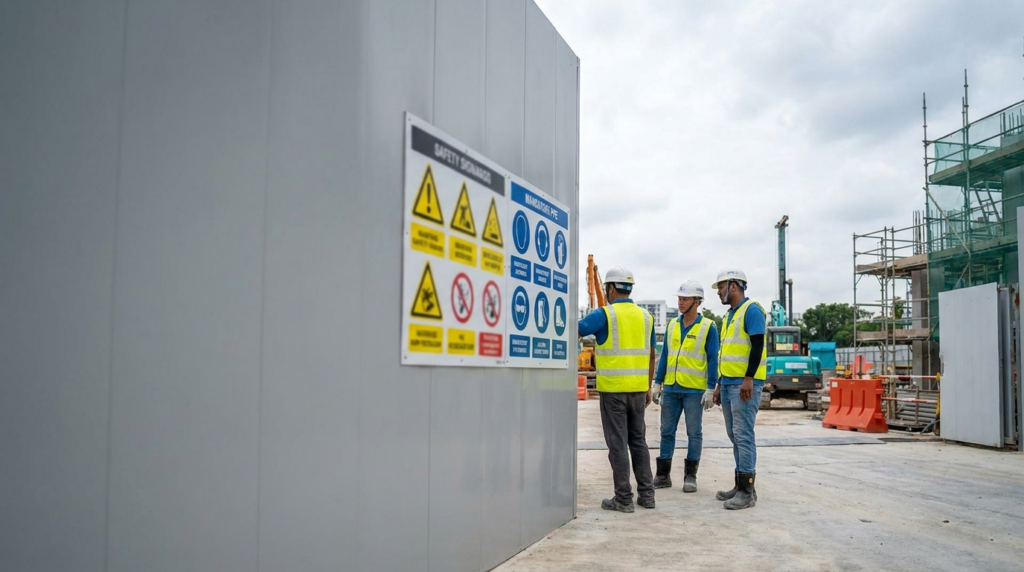
Signage sits inside every one of those basics, whether or not it gets named explicitly in the enforcement notice. A hazard warning sign posted at the point of risk is one of the simplest, cheapest ways to demonstrate that a risk assessment translated into something a worker could actually see and act on. Its absence is equally simple for an inspector to spot — and it’s often the first visible sign, literally, that a site’s paperwork and its reality have drifted apart.
The Signage Gap Nobody Budgets For
Smaller firms rarely skip signage on purpose. It usually falls through the cracks the way a lot of “we’ll sort it out later” items do: the renovation contract is short, the crew rotates between sites, and nobody owns the job of checking whether the mandatory PPE sign at the entrance still matches the actual hazards inside. Multiply that across dozens of small facilities-management and renovation contracts running at once, and it’s easy to see why MOM’s widened inspection net is catching businesses that assumed they were too small to be a target.
The fix costs far less than the alternative. A stop-work order halts every activity on site until deficiencies are independently verified as fixed — a process that can stretch from days to months, during which idle labour, liquidated damages, and a mandatory external safety audit all add up. Since mid-2024, fines for safety breaches resulting in death have risen to as much as SGD $50,000 per charge, with employer penalties reaching SGD $500,000 and up to two years’ imprisonment. Against that backdrop, a proper signage audit is one of the cheapest insurance policies a small contractor can buy.
SS 508 Isn’t Optional — And Inspectors Know It
Every workplace, construction, and fire safety sign in Singapore is expected to comply with SS 508 and carry ISO 7010-aligned pictograms — the same visual language used internationally, so a mandatory PPE sign or a prohibition sign means the same thing to a Singaporean worker as it would on a site in Rotterdam or Hamburg. That consistency is precisely why inspectors treat signage as a fast, reliable proxy for the seriousness of a site’s broader safety culture: correct, current, well-placed signage suggests a team that has actually walked the site and thought about its hazards; missing or faded signage suggests the opposite, often correctly.
For facilities managers juggling multiple sites, the practical move is a signage audit that runs alongside — not after — the broader safety management review MOM is now pushing smaller firms toward. Check that mandatory, warning, and prohibition signs are present at every point where a hazard begins, that materials suit the environment (aluminium for outdoor and high-traffic areas, photoluminescent for emergency exits and low-light zones), and that nothing on the wall still references equipment or procedures that changed six renovation projects ago.
Getting Ahead of the Next Inspection
MOM’s own numbers make the incentive clear: more than 3,000 inspections were carried out across the construction sector during the last major enforcement push, and the current uptick in fatalities suggests a similar wave is likely as 2026 continues. Businesses that treat this as a prompt to walk their sites now — rather than wait for an inspector to do it for them — are the ones that will avoid finding their name in the next stop-work order list. Browse our full range of SS 508-compliant safety signs at safetysigns.sg.
By safetysigns.sg Team