Category: Regulation Update
Singapore just posted its safest year on record — a workplace fatal injury rate of 0.96 per 100,000 workers in 2025, putting the country alongside the Netherlands and Germany. Then 2026 opened with seven deaths in four weeks, and MOM’s emergency measures are due to lapse on 31 July. The question every employer should be asking isn’t whether the Time-Out worked. It’s what happens the day after it ends.
A record year, undone in four weeks
The 2025 Workplace Safety and Health National Statistics report was, by any measure, a genuine achievement. Singapore’s fatal injury rate fell to 0.96 per 100,000 workers, and the major injury rate dropped to an all-time low of 15.7 per 100,000, excluding platform workers. Thirty-six fatalities were recorded for the year, with vehicular incidents, falls from height, and structural collapse or equipment failure accounting for 78 percent of them. Construction remained the single largest contributor, at 13 deaths.
It didn’t last. By the time the Ministry of Manpower issued its nationwide Safety Time-Out on 26 June 2026, seven workers had died in five separate incidents within a single four-week stretch, pushing the year-to-date fatality count to 21 — up from 18 over the same period in 2025. MOM’s own language framed the close succession of incidents as “a cause for concern,” which, from a regulator that had just posted a record-low year, is a notable shift in tone.
What actually changed under the enhanced measures
The response wasn’t just a symbolic pause. Alongside the voluntary Time-Out, MOM rolled out enforcement changes that raise the cost of getting safety wrong. Composition fines for first-time WSH offences detected during inspections rose from S$2,000 to S$3,000, with steeper penalties for repeat or more serious lapses. Stop-Work Orders, previously a minimum of five weeks, now run for at least eight. And in the most serious cases — where safety failures result in fatal or serious accidents — companies face a three-month ban on hiring new migrant workers.
These measures were set to run from 26 June to 31 July, with MOM stating explicitly that they “may be extended beyond 31 July should workplace safety outcomes not improve.” That’s a deadline, not a resolution. For any business managing a worksite — construction, marine, manufacturing, logistics — the practical reality is that the current elevated fine structure and longer Stop-Work Orders could either lapse back to prior levels or simply continue, and there has been no indication yet that the underlying causes of the four-week spike have been resolved.
Why signage keeps showing up in every incident review
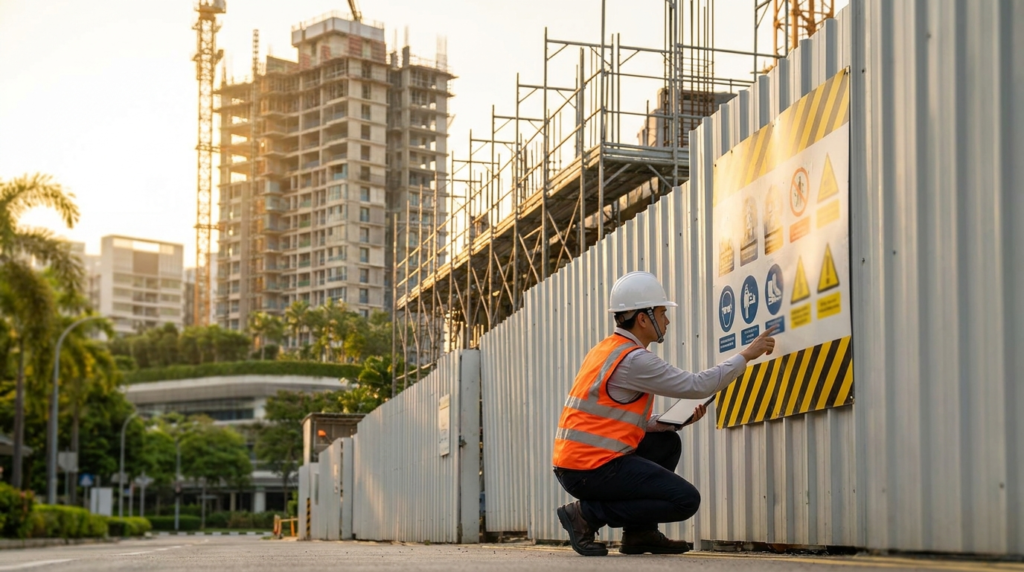
Falls from height and structural or equipment failure alone account for the majority of Singapore’s workplace deaths, and both categories share a common failure point: hazard visibility. A worker who doesn’t clearly register that a floor opening is unprotected, that a load path is compromised, or that machinery is under lockout doesn’t need more training in the moment — they need the hazard to be unmistakable before they walk into it. SS 508, the Singapore Standard aligned with ISO 7010, exists precisely because consistent shapes, colours and pictograms let a worker recognise danger in under a second, regardless of the language they read.
That’s also where enforcement scrutiny tends to land first. When MOM or an SCDF inspector walks a site during a period of heightened inspection activity — which is exactly what an enhanced enforcement window produces — missing, faded, or non-compliant signage is one of the fastest, most visible compliance gaps to flag. It’s also one of the cheapest to fix relative to the fines now in play: a S$3,000 composition fine for a first-time offence dwarfs the cost of replacing a worn prohibition sign or adding mandatory PPE signage at a machinery zone.
The gap between “time-out” and “standard practice”
The uncomfortable pattern in Singapore’s WSH data is that safety attention tends to spike reactively — after a cluster of deaths — rather than holding steady as routine practice. A two-week national pause, however well-intentioned, is not a substitute for the ongoing discipline of risk assessments, signage audits, and PPE checks that MOM’s own record-low 2025 numbers suggest actually work when sustained. The employers who benefit most from an enhanced enforcement window are the ones who were already close to compliant before it started, because the marginal cost of catching up during a spot-check period is far higher than the cost of staying current.
With the 31 July deadline approaching and MOM leaving the door open to extend enforcement, this is a reasonable moment for any facilities or WSH manager to walk their site with the same checklist an inspector would use: are prohibition, mandatory, warning and safe condition signs present at every hazard point, correctly coloured, and still legible? Is photoluminescent signage in place wherever emergency routes run through low-light areas? These are not expensive fixes. They are, however, exactly the kind of gap that turns a routine inspection into a Stop-Work Order under the current rules.
Conclusion
Singapore’s 2025 safety record proves the system works when it’s followed consistently — and its 2026 start proves how quickly that progress can slip. Whether or not MOM extends the enhanced enforcement measures past 31 July, the fines, Stop-Work Order durations, and inspection scrutiny they introduced are a preview of where policy is heading. The lowest-cost way to stay ahead of it is making sure every hazard on site is marked the way SS 508 requires, before an inspector — or a preventable accident — finds the gap first. Browse our full range of SS 508-compliant safety signs at safetysigns.sg.
Author: safetysigns.sg Team
Date: 21 July 2026