REGULATION UPDATE
From 1 September, an enhanced Top Executive WSH Programme raises the bar for what Singapore expects of CEOs and board directors — not their safety officers, not their contractors, them personally. Announced at last week’s WSH Conference against a backdrop of 21 workplace deaths this year, it is the clearest signal yet that MOM believes safety culture is set at the top, or not at all.
The Announcement Everyone Almost Missed
The Workplace Safety and Health Conference 2026 at Marina Bay Sands produced a crowded news cycle: a new tripartite alliance, an AI safety tool, a WhatsApp advisory channel. Tucked among them was a line that lands squarely on the desks of Singapore’s most senior executives — an enhanced Top Executive WSH Programme takes effect on 1 September 2026. The programme itself is not new. Since 1 March 2024, at least one top executive — the CEO or a board director responsible for WSH — from every company in the Construction, Manufacturing, Marine, and Transport & Storage industries has been required to complete it, along with any company employing work pass holders in the Construction, Manufacturing, Marine shipyard or Process sectors. What changes in September is the weight the programme carries, and the timing tells you why.
Twenty-One Reasons the Bar Just Rose
Singapore recorded 21 workplace fatalities by late June this year, up from 18 at the same point in 2025, with a troubling cluster of incidents between April and July. The Ministry of Manpower’s response has been layered: a nationwide voluntary Safety Time-Out, an intensified enforcement window, and now a sharpened focus on the one variable that MOM’s own accident investigations keep circling back to — leadership. The existing programme already covers the Approved Code of Practice on chief executives’ and board directors’ WSH duties, root cause analysis of top incident types, and the legal responsibilities of top executives under Section 48 of the WSH Act. That last item deserves a careful read. Section 48 puts officers of a company personally in the frame when an offence is committed with their consent, connivance or neglect. This is not a compliance seminar; it is a briefing on personal legal exposure.
What a Director Should See on a Site Walk
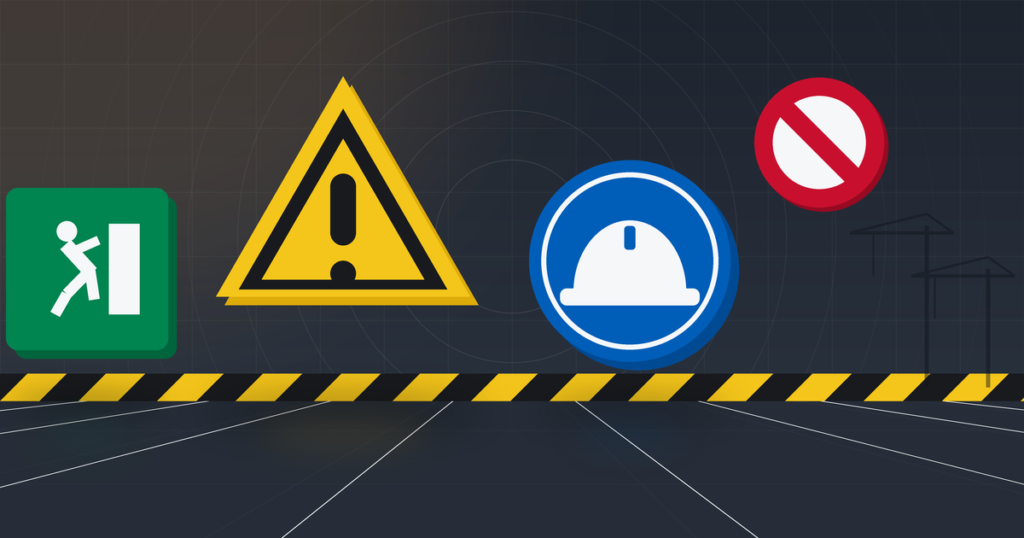
Here is where the programme’s classroom content meets the concrete floor. One of the modules teaches executives how to shape WSH culture and systems — and the fastest audit of a company’s safety culture is the one a director can do with their own eyes. Walk any site or factory floor your company operates and ask a simple question: can I tell, from what is posted on the walls, what could hurt someone here? A workplace that takes safety seriously answers that question in seconds. Hazards are flagged with yellow SS 508 warning triangles. PPE requirements are stated in blue mandatory circles at every entry point — see our workplace safety signs. Prohibited actions — smoking near flammables, unauthorised entry — are marked in red with prohibition signs before anyone can commit them. Escape routes read clearly in green with fire safety signage, even if the lights fail. A workplace where signage is faded, missing, improvised on laminated A4 paper, or contradicted by what workers actually do is telling its leadership something — and from September, leadership is formally expected to know how to read it.
The Paper Trail Starts With the Wall
There is a practical reason signage belongs in a boardroom conversation, beyond symbolism. When MOM investigates an incident, the visible state of a workplace becomes evidence of the system behind it. Risk assessments are supposed to translate into controls, and signage is the most inspectable control there is — either the confined space entry was marked or it wasn’t; either the forklift zone was demarcated or it wasn’t. For a top executive who has just completed the TEWP and understands their Section 48 exposure, ensuring the company’s signage matches its risk register is one of the cheapest, fastest acts of due diligence available. A full SS 508-compliant signage set for a typical SME premises costs a few hundred dollars. The programme now teaches executives what neglect looks like in a courtroom; a compliant workplace is how you make sure no one ever has to argue the point.
September Is Closer Than It Looks
The enhanced programme takes effect on 1 September — five weeks away. Companies in the mandatory sectors that have not yet put an executive through the TEWP are already behind the March 2024 requirement, and the enhancement is unlikely to make that conversation with MOM more comfortable. For everyone else, the direction of travel is clear enough to act on voluntarily: MOM is spending 2026 building an accountability chain that runs from the boardroom to the noticeboard, taking in AI photo audits, tighter enforcement and executive education along the way. The organisations that will find all of this uneventful are the ones whose safety systems — signage included — already say what their risk assessments say.
The Takeaway
Safety culture is now, formally and legally, a leadership deliverable in Singapore. The enhanced Top Executive WSH Programme makes sure every mandated CEO and board director knows what good looks like — and the walls of your workplace are where that knowledge becomes visible first. Before September arrives, walk your site the way a trained director would, and fix what the walk reveals. Browse our full range of SS 508-compliant safety signs at safetysigns.sg.
By the safetysigns.sg Team · 28 July 2026