REGULATION UPDATE
On 8 September, the Ministry of Manpower confirmed what its own numbers had been signalling for months: Singapore’s workplace fatal injury rate climbed to 1.1 per 100,000 workers in the first half of 2026 — above the 1.0 ceiling the country set itself for 2028. The response wasn’t another advisory. It was a promise to rewrite how MOM scores whether a workplace is actually safe.
A Rate That Broke Its Own Promise
Back in 2017, MOM set itself a target: get the national workplace fatal injury rate below 1.0 per 100,000 workers by 2028, and keep it there. For most of the years since, the trend line cooperated — the rate fell as low as 0.96 in the second half of 2025, a genuine record. The first half of 2026 broke that pattern. Twenty-one workplace deaths pushed the annualised fatal injury rate to 1.1, and MOM said so plainly in its 8 September release of the 1H2026 WSH Report, alongside an unusual admission: the ministry is now reviewing “further measures to strengthen ownership and accountability over workplace safety and health,” specifically the workplace safety demerit points system and whether the bizSAFE programme still reflects how safely a company actually operates. Minister of State for Manpower Dinesh Vasu Dash called the fatality rise “a serious concern” in the same breath as praising an all-time-low major injury rate — a split verdict that sums up where Singapore’s safety picture stands right now: quietly improving in the numbers that measure near-misses and close calls, and visibly worse in the number that measures who doesn’t go home.
Where the Numbers Actually Moved
The headline rate hides a more specific story. Vehicular incidents caused nine of the 21 fatalities, four of them platform workers — consistent with a problem MOM has been chasing since forming its Platform Worker Safety Workgroup in March. Major injuries, meanwhile, fell to 314 for the half-year, pulling the annualised major injury rate to 14.6 per 100,000 workers, the lowest ever recorded outside the pandemic-disrupted year of 2020. Construction posted 69 fatal and major injuries at an annualised rate of 24.1 — also its lowest since 2020 — but MOM flagged a specific soft spot inside that improving picture: smaller-scale renovation and alteration works saw a slight uptick, prompting a promised review of deterrence and accountability measures aimed specifically at the contractors who run them. Manufacturing told a less forgiving story. Sixty-two fatal and major injuries at a 28.4 annualised rate, with metalworking the clear driver — cases there jumped from 18 to 28 year-on-year, enough that MOM committed to maintaining a higher inspection frequency in the sector, focused squarely on machinery safety and slip, trip and fall risks.
What “Reviewing the Demerit Points System” Actually Means for a Site
The demerit points system already works like a licence: accumulate 25 points from WSH Act breaches and a company faces debarment, with every work-pass application for migrant workers automatically rejected until the record clears. MOM hasn’t published what changes it’s considering, but the direction is legible from what it said alongside the review — this follows tighter penalties introduced back in June, including higher composition fines and a tougher two-week Safety Time-Out, after an earlier spate of deaths. A system already built to escalate consequences for poor safety records is, by MOM’s own account, being examined for whether it escalates hard enough. The same goes for bizSAFE, the certification more than 100,000 Singapore companies use as shorthand for “we take this seriously” — MOM is now asking whether that shorthand still tracks real-world performance. For any site operator, the practical read is the same either way: whatever inspectors check today to score a site’s compliance is likely to matter more, not less, once this review lands. Visible compliance — correctly displayed hazard, mandatory and prohibition signage at every point the WSH Act requires it — is one of the few things an inspector can verify in the first five minutes on site, before a single document gets pulled.
The Metalworking Floor Is Where Inspectors Are Headed Next
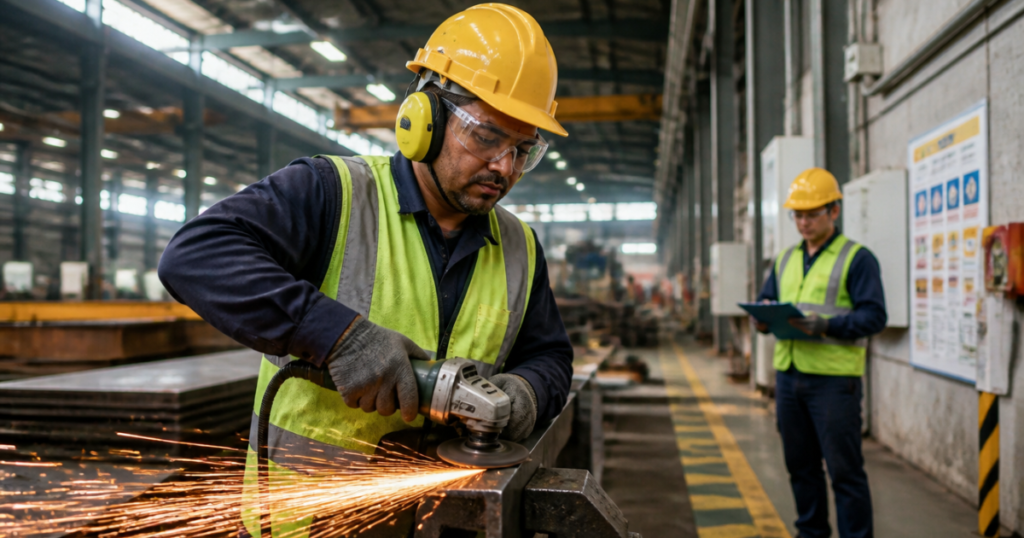
MOM’s decision to name metalworking specifically, and to commit to higher inspection frequency there, is worth sitting with. A 56% jump in cases (18 to 28) in one sector, inside a half-year where the national injury rate was otherwise falling, is the kind of number that turns a routine inspection into a scheduled one. The stated focus — machinery safety and slip, trip and fall risks — points straight at signage that’s easy to treat as optional until an inspector asks for it: machine-specific hazard warnings at point of use, mandatory PPE signage (hearing protection in particular, given noise-induced hearing loss already accounts for 354 of the half-year’s 620 occupational disease cases), and floor-level warning markers at wet-process and walkway transitions. None of it is new law. What’s changing is the likelihood that someone checks.
The Bottom Line for Employers
Singapore’s safety story in 2026 isn’t a collapse — the major injury numbers say the opposite. But a ministry that just missed its own target, in public, on the same day it announced it’s reviewing how compliance gets scored, is not a ministry likely to ease inspection pressure over the next six months. Metalworking sites and smaller renovation contractors — see our range of construction site signage — are the two groups MOM named directly; every other sector should read that as this quarter’s early warning, not next year’s problem. Browse our full range of SS 508-compliant safety signs at safetysigns.sg.
Author: safetysigns.sg Team
Date: 18 September 2026