REGULATION UPDATE
The Ministry of Manpower’s mid-year numbers tell two different stories at once: major workplace injuries falling to their lowest rate on record, and workplace deaths climbing past last year’s pace. Nine days after the H1 2026 report reopened that gap, the Workplace Safety and Health Council quietly launched a free onsite audit programme built to close it — and what it checks first is rarely the reason companies think they’re being visited.
A Good Half-Year, Read Two Ways
MOM’s first-half 2026 workplace safety and health report, released in early September, gave employers a genuine milestone: the annualised major injury rate fell to 14.6 per 100,000 workers, down from 15.8 a year earlier and the lowest figure since records began. Construction — the sector that usually drags the national average down — posted its own record, with a combined fatal-and-major injury rate of 24.1 per 100,000, its best showing since 2020. Read in isolation, that’s a genuine win, and MOS Dinesh Vasu Dash said as much at the WSH Awards on 24 September, telling more than 2,200 attendees that Singapore’s workplace safety record remains “world-class.”
The same report carried a second number that complicates that story. The annualised fatal injury rate rose to 1.1 per 100,000 workers, up from 0.97 in the first half of 2025 — 21 deaths in six months, nine of them involving vehicles. Platform workers, a small enough group that a handful of incidents move the rate sharply, saw 38 of their 44 fatal-and-major injuries come from vehicular incidents too. MOM’s own framing was unusually direct: a two-week nationwide voluntary Safety Time-Out followed seven deaths in late May and June, enforcement penalties were increased, and the bizSAFE certification scheme itself is now under review.
The Part the Averages Don’t Show
The construction sector’s record-low injury rate sits alongside a detail that matters more than the headline number: smaller-scale construction work — the renovation job, the shophouse retrofit, the small commercial fit-out that never shows up in a news report about a major project — accounted for 70% of the sector’s fatal and major injuries in H1 2026. Big, well-resourced sites with full-time safety officers and established WSH systems are getting measurably safer. The long tail of smaller contractors, subcontractors, and one-off jobs is where the risk is concentrating instead, and it’s exactly the segment least likely to have a dedicated safety budget, a signage plan, or anyone whose job it is to check either.
MOM’s Answer: A Free Audit for Every Company, Not Just the Ones Already Enrolled
That gap is the backdrop for StaySAFE, the programme the WSH Council launched at the same 24 September WSH Awards ceremony where the H1 numbers were being discussed. StaySAFE replaces both the old StartSAFE scheme and the separate WSH Assistance Visits programme, and the change that matters most is eligibility: StartSAFE was aimed at SMEs and bizSAFE participants specifically, while StaySAFE is open to any company, regardless of size or existing certification. Registration is free. A certified WSH professional — assigned through Ardent Safety Consultancy or Fullerton Healthcare Group — visits onsite for roughly four hours, reviews current practices against current legal obligations, and produces a formal StaySAFE report flagging improvement priorities in order.
What that visit actually checks first is where the programme becomes relevant to anyone running a worksite rather than just reading about one. A root-cause review of past incidents and a risk diagnostic of current operations both start with the fastest, cheapest thing to verify: is the site marked the way the law requires it to be marked. Missing or wrong signage doesn’t cause an accident on its own, but it’s the item every WSH inspection, insurance audit, and now StaySAFE visit checks in the first few minutes — precisely because it’s the easiest gap to close and the easiest one to have quietly let slide. For the smaller contractors carrying 70% of construction’s incident load, a StaySAFE visit is a free chance to find that gap before MOM does.
What This Means Before Your Next Visit
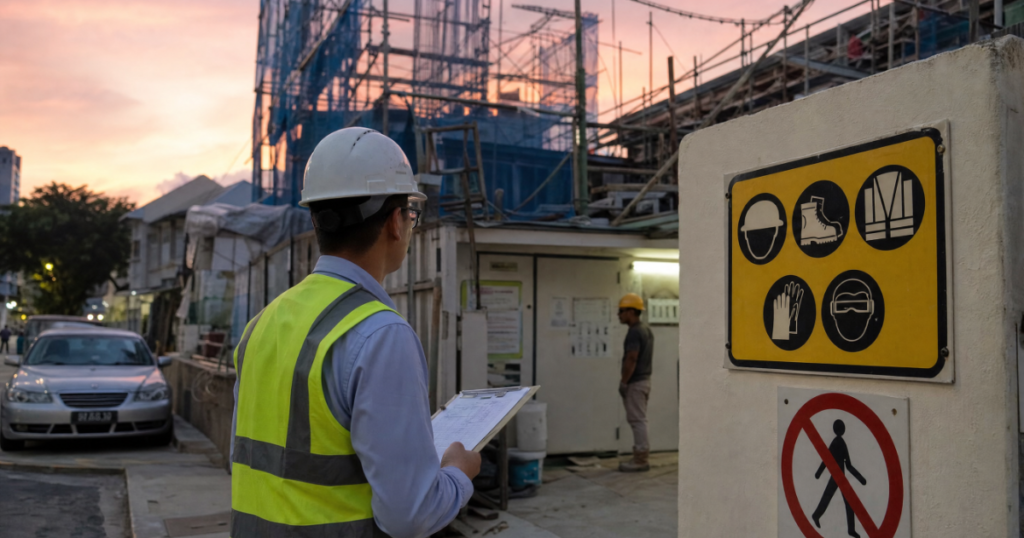
None of this requires waiting for a scheduled audit. SS 508-compliant signage — mandatory PPE signs at entry points, prohibition signs on restricted zones, clearly marked vehicle and pedestrian segregation lines given how much of H1’s fatality toll was vehicular — is the fastest, most visible fix available to any company reading this before StaySAFE ever calls. Registering for the free visit is worth doing regardless; making sure the site would pass on sight is worth doing today. Browse our full range of SS 508-compliant workplace and mandatory safety signs at safetysigns.sg, or see our Complete Business Owner’s Guide to Safety Signs in Singapore for the full picture.
Author: safetysigns.sg Team
Date: 29 September 2026