REGULATION UPDATE
From 1 January 2027, every forklift operator in Singapore must have completed a refresher training course within the past three years — or they’re no longer authorised to operate. MOM’s own inspection data shows close to eight in ten forklift-related violations already trace back to exactly this lapse, and with 107 days left on the clock, the gap between “trained once” and “compliant now” is where the next fatality is most likely to happen.
A Rule Three Years in the Making
The mandatory Forklift Operator Refresher Training requirement didn’t appear overnight. The Ministry of Manpower first flagged it on 6 November 2024, alongside an enhanced refresher curriculum, and formalised it in a circular issued on 3 January 2025 under Section 31(4) of the Workplace Safety and Health Act. The mechanics are simple even if the compliance burden isn’t: every forklift operator must complete a refresher course at least once every three years, and from 1 January 2027, occupiers, employers and principals are responsible for ensuring no forklift is authorised to operate without one on file. Unlike a voluntary advisory, this is a hard licensing-style gate — an operator who hasn’t refreshed in time isn’t a compliance risk sitting in the background, they’re simply not supposed to be behind the controls.
Why MOM Went After Forklifts Specifically
The rule exists because the data left little room for ambiguity. Between 2022 and 2023, vehicular incidents were Singapore’s leading cause of fatal workplace injuries, and roughly one in four of those vehicular deaths involved a forklift. When MOM’s inspectors went looking for the root cause, they didn’t find a training gap so much as a training decay gap: close to eight in ten forklift-related contraventions involved operators who held a valid original certification but had gone more than three years without any refresher. In other words, the qualification itself wasn’t the problem — memory, habit drift and outdated hazard awareness were. A worker trained in 2019 was, on paper, still “certified” in 2026, while in practice operating with seven-year-old instincts around blind corners, pedestrian zones and load limits that newer guidance has since sharpened.
What the Enhanced Course Actually Covers
The refresher isn’t a repeat of basic certification. MOM’s redesigned syllabus leans on real incident case studies, hands-on scenario practice, and a specific focus on the failure patterns its own inspections keep surfacing: pedestrian-forklift interactions in shared aisles, unstable or overloaded lifts, and inadequate visibility at racking corners and loading bays. Employers should treat the three-year clock as a floor, not a target — a workforce with high forklift usage, frequent near-misses, or recent new hires arguably needs the refresher cadence tightened further, not stretched to the legal minimum. With 107 days remaining before the mandate takes effect, any operator whose last course sits close to or past the three-year mark should already be booked into a session, not waiting for a compliance audit to surface the gap.
The Signage Gap That Sits Right Next to This One
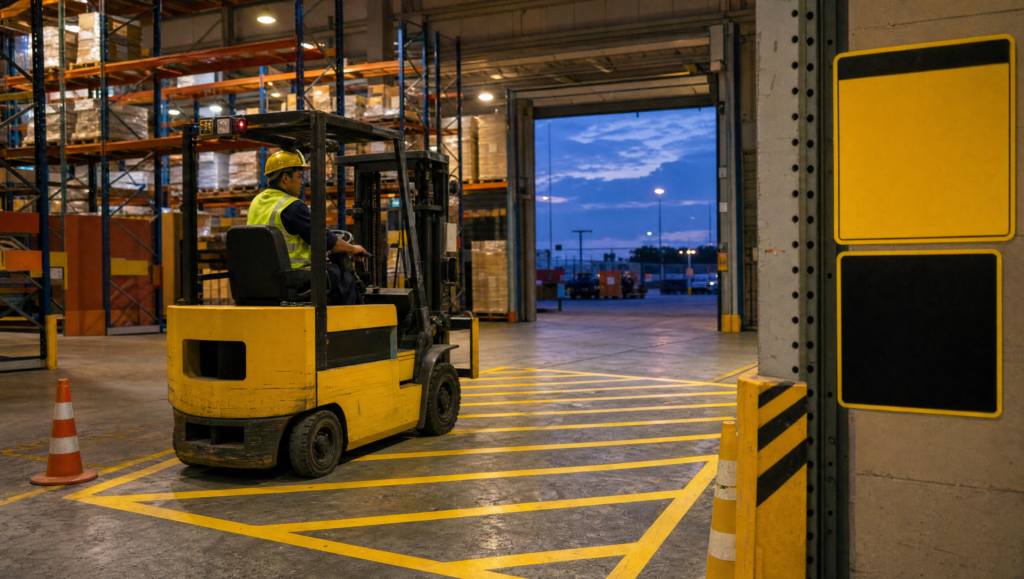
Retraining the operator solves half the equation; the other half is whether the physical environment still tells that operator — and everyone walking near them — where the danger actually is. MOM’s own guidance on vehicular safety pairs refresher training with clearly marked exclusion zones, speed limit signage, and pedestrian warning signs at every point where forklifts and foot traffic cross paths, because a well-trained operator moving through an unmarked or faded warehouse layout is still working with degraded information. Racking aisles that have been re-configured since the signage was last reviewed, loading bays with no visible speed limit marker, and blind corners without a convex mirror or warning sign are common findings in MOM’s post-incident reports — and every one of them is cheaper and faster to fix than a training backlog. Employers walking their warehouse ahead of the 2027 deadline should treat it as a two-item checklist: confirm every forklift operator’s refresher date, and confirm every hazard point they operate near is still marked to current SS 508 standards.
Getting Ahead of a Deadline That Won’t Move
MOM has not signalled any grace period beyond 1 January 2027, and the inspection data behind the rule suggests enforcement will focus exactly where the old contraventions were found — lapsed refreshers and unmarked vehicle zones. Employers who use the next 107 days to close both gaps at once, rather than treating training and signage as separate projects, will walk into the new year with a warehouse that can withstand an inspection rather than one racing to catch up after the fact. Browse our full range of SS 508-compliant warning and mandatory signs for forklift and warehouse safety at safetysigns.sg.
Author: safetysigns.sg Team
Date: September 16, 2026