WORKPLACE SAFETY
MOM’s mid-year report showed occupational disease cases climbing to 620 in the first half of 2026, up from 485 a year earlier — and noise-induced hearing loss, at 57% of cases, absorbed most of the attention. The condition sitting just behind it has been one of Singapore’s three most-reported occupational diseases for over a decade, yet on most worksites there is almost nothing posted to warn a worker before it happens.
A Report That Named One Villain and Missed Another
When the Ministry of Manpower released its mid-year Workplace Safety and Health Report on 8 September, the headline number was hard to miss: 620 occupational disease cases in the first half of 2026, up from 485 in the same period the year before. Noise-induced hearing loss took the credit for most of that rise, accounting for 57% of all cases and prompting its own round of coverage, advisories, and — on this site two weeks ago — its own explainer. What got far less airtime is the category that has quietly sat in Singapore’s top three occupational diseases for more than a decade: work-related musculoskeletal disorders, or WRMSDs. Between 2020 and the first half of 2024, Singapore averaged 338 reported WRMSD cases a year, with 91% of them back injuries and the rest affecting the upper limb. Unlike a sudden fall or a struck-by incident, none of these cases come with a single dramatic moment MOM can point to. They accumulate, one lifted crate or one awkward reach at a time, which may be exactly why they don’t generate the same urgency as a fatality count.
The Anatomy of an Invisible Injury
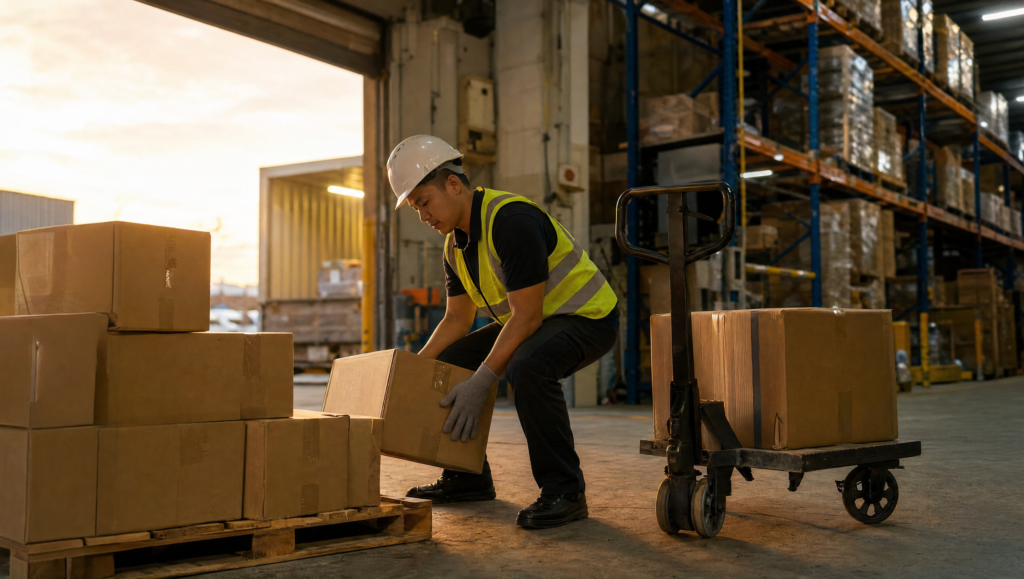
A WRMSD doesn’t announce itself the way a laceration or a fracture does. It builds from repeated manual handling, awkward postures, and sustained over-exertion — the everyday mechanics of moving goods, patients, or materials — until a worker’s back, shoulder, or wrist simply stops cooperating. The Workplace Safety and Health Council classifies manual handling as the leading risk factor, and the industries most affected read like a cross-section of the economy: manufacturing, transport and storage, healthcare, hospitality, and ordinary offices with nothing more hazardous than a bad chair. That breadth is part of the problem. A construction site’s fall risk is concentrated and visible; a warehouse’s lifting risk is diffuse, spread across every trolley run and every top shelf, which makes it far easier for a business to underestimate until the medical certificate arrives.
Where Signage Ends and the Risk Begins
Walk into almost any regulated worksite in Singapore and the signage for acute hazards is hard to miss — mandatory PPE signs at entry points, prohibition signs around live equipment, hazard triangles wherever a chemical or a moving part demands attention. That system exists because SS 508 and the WSH Act treat those risks as ones a sign can meaningfully prevent, by putting the warning at the exact point a worker needs it. Manual handling risk gets almost none of that treatment. The WSH Council has published detailed Guidelines on Improving Ergonomics in the Workplace, covering safe lifting technique, mechanical aids, and workstation design, but very few of those recommendations translate into a physical reminder at the loading bay, the storeroom shelf, or the workstation where the actual lifting happens. The guidance exists; the signage that would put it in front of a worker at the moment of risk generally doesn’t.
What MOM Already Requires, and What It Doesn’t
The regulatory asymmetry is worth sitting with. A WRMSD of the upper limb is a reportable occupational disease under the WSH (Incident Reporting) Regulations — employers must notify MOM within 10 days of a worker being diagnosed by a registered medical practitioner. That’s a real, enforced obligation, but it sits entirely on the back end, after the injury has already happened. Compare that to noise exposure, where designated high-noise zones typically carry mandatory hearing-protection signage before anyone sets foot inside. Manual handling has no equivalent front-end trigger. There is no standard sign that says “mechanical lifting aid required beyond this point” or “team lift only” the way there is a sign that says “hearing protection must be worn.” The reporting duty exists; the prevention prompt largely doesn’t.
The Fix Costs Less Than the Diagnosis
None of this requires new legislation to start closing. A loading bay with a posted safe-lifting-technique sign, a storeroom with a maximum-manual-lift-weight marker, a workstation zone flagged for mandatory ergonomic breaks — these are the same category of low-cost, high-visibility interventions that already work for noise, chemicals, and PPE elsewhere on the same site. The economic case has been on the books for years: WRMSDs were estimated to cost the Singapore economy around $3.5 billion, roughly 1% of GDP, in lost productivity and compensation — a figure that predates this year’s reporting expansion and is likely conservative today. Set against that, the cost of a set of manual-handling and ergonomics signs for a warehouse or production floor is negligible. The gap isn’t awareness of the risk; MOM and the WSH Council have documented it thoroughly. The gap is that almost nothing about it is posted where a worker actually lifts.
As MOM’s own numbers show, the fastest-growing categories of harm in Singapore’s workplaces aren’t always the ones that make the news. Closing the gap between what the WSH Council recommends and what’s actually visible on the floor starts with putting the right reminder in the right place. Browse our full range of SS 508-compliant safety signs at safetysigns.sg.
Author: safetysigns.sg Team
Date: September 20, 2026