WORKPLACE SAFETY
Every fall hazard gets a barricade and every forklift aisle gets a warning triangle — but the hazard now injuring outdoor workers across Singapore has no edge to guard and no machine to fence off. It rises off the tarmac at 1pm, and last year it crossed the danger threshold on 29 separate days. Here’s why heat belongs on your risk assessment, and on your signage plan.
The Numbers Are Moving in the Wrong Direction
According to the Workplace Safety and Health Council, Singapore recorded 29 high heat stress days in 2025 based on Wet Bulb Globe Temperature (WBGT) monitoring — up from 21 days in 2024. That is nearly a 40 per cent jump in the number of days when outdoor work became measurably more dangerous. The Council’s advisory this year urged companies to treat heat as a core WSH risk, not a comfort issue: elevated heat exposure doesn’t just cause heat illness, it erodes concentration and reaction time, which is exactly when struck-by and fall incidents happen. With 21 workplace fatalities already recorded in 2026 — up from 18 over the same period last year — and MOM’s enhanced enforcement measures running until 31 July, no site can afford a hazard that quietly degrades every other safety control.
What MOM Actually Requires When the WBGT Climbs
Under the Workplace Safety and Health Act, employers must assess environmental risks — including heat and UV exposure — and put in reasonably practicable controls. MOM’s heat stress framework for outdoor work spells out what that looks like in practice: monitor WBGT levels and adjust work accordingly, acclimatise new workers and those returning from more than a week away, provide well-ventilated shaded rest areas, keep cool drinking water within reach of work zones, shift heavy work to cooler parts of the day, and train supervisors to spot the early signs of heat illness. Employers are also required to report diagnosed heat illness cases to MOM under the WSH incident reporting regime. These are not suggestions — they are the standard an inspector will measure your site against, and inspections are running at elevated intensity through the end of this month.
Heat Is Invisible. Your Controls Shouldn’t Be.
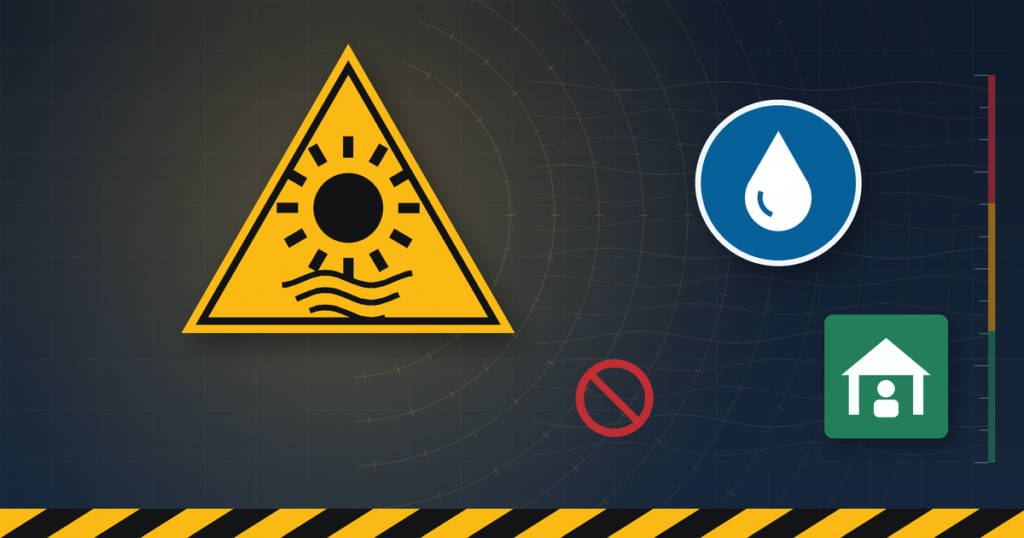
Here is the practical problem with every measure on that list: they only work if workers can find them fast. A shaded rest area that new subcontractors don’t know exists provides no rest. A water point behind a container provides no hydration to the worker who has never walked past it. This is where signage does quiet but real work. Green safe-condition signs under SS 508 marking rest shelters and first aid stations, clear directional signs to drinking water points, and blue mandatory signs reinforcing hydration and rest-break rules turn a paper heat management plan into something a worker on his sixth hour under the sun can actually use. In an emergency, a green first aid sign that can be seen across the yard shortens the minutes that decide whether heat exhaustion becomes heat stroke.
Where Warning Signs Fit In
SS 508 and ISO 7010 also give you the amber layer: hot surface warnings (W017) for plant, pipework and metal structures that bake in the afternoon sun, and general warning signage for enclosed or poorly ventilated zones — container interiors, plant rooms, under-deck spaces — where WBGT readings run hotter than the open yard. Sites that map their high-heat zones during the risk assessment and then mark them are doing what the framework intends: making an invisible hazard visible at the exact spot a worker encounters it. It is the same logic as a forklift aisle triangle, applied to a hazard you can’t see coming.
A One-Afternoon Heat Signage Audit
Walk your site tomorrow at 1pm and ask four questions. Can a worker standing at the furthest work point see or recall the way to shade? Is every water point marked and actually stocked? Does the first aid station stand out from fifty metres? Are your known hot zones — west-facing scaffolds, metal decks, container stacks — marked in any way? If any answer is no, the fix costs less than the composition fine for a single WSH lapse, which MOM has just raised to S$3,000. The inter-monsoon heat will be back every year; the signage only has to go up once.
Heat stress is the rare hazard where the controls are cheap, the rules are clear, and the calendar tells you exactly when to act. Get the shade, water and first aid points in place — then make sure every worker can find them at a glance. Browse our full range of SS 508-compliant safety signs at safetysigns.sg.
Author: safetysigns.sg Team
Date: 4 July 2026