WORKPLACE SAFETY
On 5 July 2026, a 24-year-old sea sports instructor was killed by lightning off Pasir Ris Beach while the main storm cloud was still kilometres away — a “bolt from the blue” that struck before anyone nearby saw a flash or heard thunder. Singapore’s official guidance for outdoor work is built entirely on hearing that thunder or seeing that flash. The Pasir Ris case shows exactly how late that can be.
A Death That Showed Lightning Doesn’t Wait for Rain
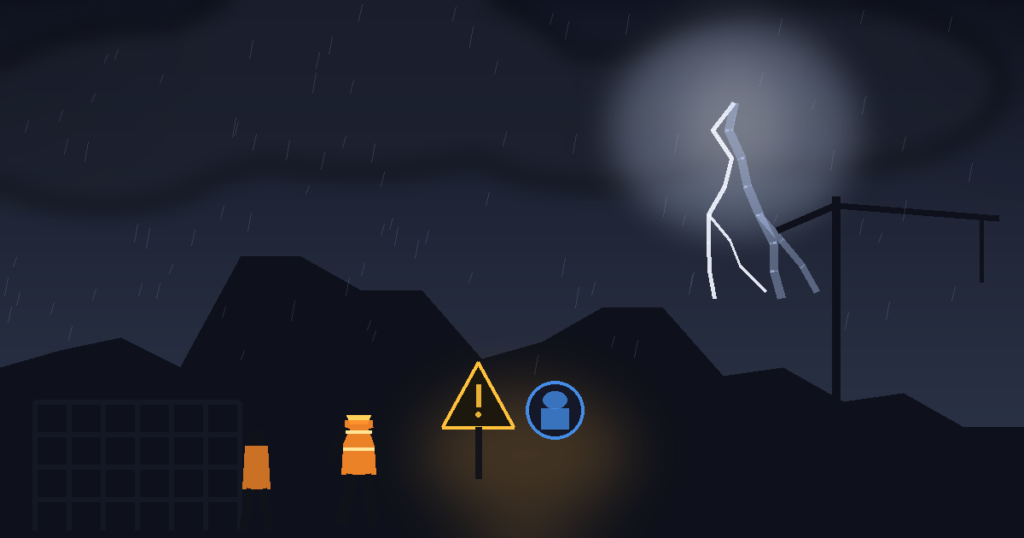
Mikhail Benyamin was paddleboarding off Pasir Ris Beach at around 4:46pm on 5 July when lightning struck the water near him; he was taken to Sengkang General Hospital and later died of his injuries, with six others also hospitalised. The Meteorological Service Singapore’s explanation afterwards was the unsettling part: the main thunderstorm cloud was still several kilometres away, and lightning can discharge well outside the cell producing it, even with no rain falling and no storm visibly overhead. Open, exposed spaces — beaches, fields, rooftops, construction yards — carry the highest risk precisely because there’s nothing around to intercept the strike. It was a tragedy at the beach, but the physics are identical on a crane deck, a rooftop installation, or an open logistics yard anywhere in Singapore, a country that sees lightning on roughly 176 days a year — among the highest rates on Earth.
What MOM’s Guideline Actually Requires
Singapore’s WSH Guidelines on Preparing for Adverse Weather give lightning its own dedicated section, built around a simple sequence: anticipate, communicate, stop work, take shelter. The operative line is direct — outdoor work must stop “once thunder is heard or lightning is seen” — and employers are told to set up a communication system so supervisors can notify workers of lightning activity and to subscribe to a lightning-alert service. It’s a sound framework on paper. The problem Pasir Ris exposed is the trigger condition itself: “heard or seen” assumes a worker gets a sensory warning before the strike. A bolt from a cloud several kilometres away, with no accompanying rain, can arrive with no usable warning at all for anyone relying on their own eyes and ears.
The Gap Between a Phone Alert and a Posted Protocol
Following the Pasir Ris incident and the parliamentary questions it prompted in August, NEA confirmed its myENV app already pushes real-time alerts for detected lightning within a 6km radius and forecasts thundery conditions up to two hours ahead, with a revamp planned to make it easier to use. That’s a genuinely useful tool — for a worker who has their phone on them, has notifications on, and can hear or feel it go off over machinery noise, through PPE, inside a site hut, or thirty metres up a scaffold. MOM’s own guideline leans on exactly that same assumption from the other direction: a supervisor “communicating” lightning activity still depends on someone noticing an alert, then relaying it, before a crew spread across an open site gets the message. Neither the app nor the guideline’s communication step is a posted, site-level protocol that every worker can see without a working phone, a line of sight to a supervisor, or a flash they’re unlucky enough to catch in time.
What a Compliant Outdoor Site Should Have Instead
The fix sits squarely in the same category SS 508 already covers for every other administrative control on a Singapore worksite: a sign posted where the risk actually is. An outdoor site with any exposed working area — rooftop, yard, scaffold, open excavation — should have a clearly marked lightning-safety assembly point and shelter location sign visible from the work area itself, not just a WhatsApp message from a supervisor. A posted outdoor-work suspension procedure at the site entrance, naming the designated shelter and the all-clear signal, turns “stop work once lightning is seen” from a judgement call made under pressure into a rehearsed, visible routine every worker — including subcontractors and visitors who never got the toolbox talk — can follow on sight. None of this replaces the myENV app or the supervisor call chain; it closes the gap between the moment an alert fires and the moment every single person on an exposed site actually knows what to do.
A guideline that depends on hearing thunder is only as good as the worst-case distance between a worker and that thunderclap, and Pasir Ris showed that distance can be zero warning at all. Signage that marks the shelter point before the sky changes is the one part of the protocol that doesn’t depend on a phone signal, a lucky glance upward, or a shout carrying over site noise. Browse our full range of SS 508-compliant warning signs and mandatory PPE signs at safetysigns.sg, or see our guide to construction site signage requirements under the WSH Act for the full picture.
Author: safetysigns.sg Team
Date: 3 October 2026