Seven work-related traffic deaths in the first half of 2026 have already topped all of last year’s total, and MOM says the pattern is depressingly familiar: a worker on foot, a reversing vehicle, and a driver who never saw them. As new WSH Council rules take effect, the signage on your worksite may be the cheapest, fastest fix available.
A Statistic Singapore Can’t Ignore
Vehicular incidents were the single leading cause of workplace deaths in 2025, responsible for 15 of the 36 fatalities MOM recorded that year. Halfway through 2026, the trend has gotten worse, not better: seven work-related traffic fatalities were logged in the first six months, already surpassing 2025’s full-year count. Four of those involved platform workers, double the figure from the year before. The Ministry of Manpower has since convened a Platform Worker Safety Workgroup with the labour movement and platform operators, and the Workplace Safety and Health Council has taken the unusual step of naming a single failure mode as the common thread: a worker struck in the blind spot directly behind a reversing truck or machine.
Why Reversing Vehicles Are the Recurring Killer
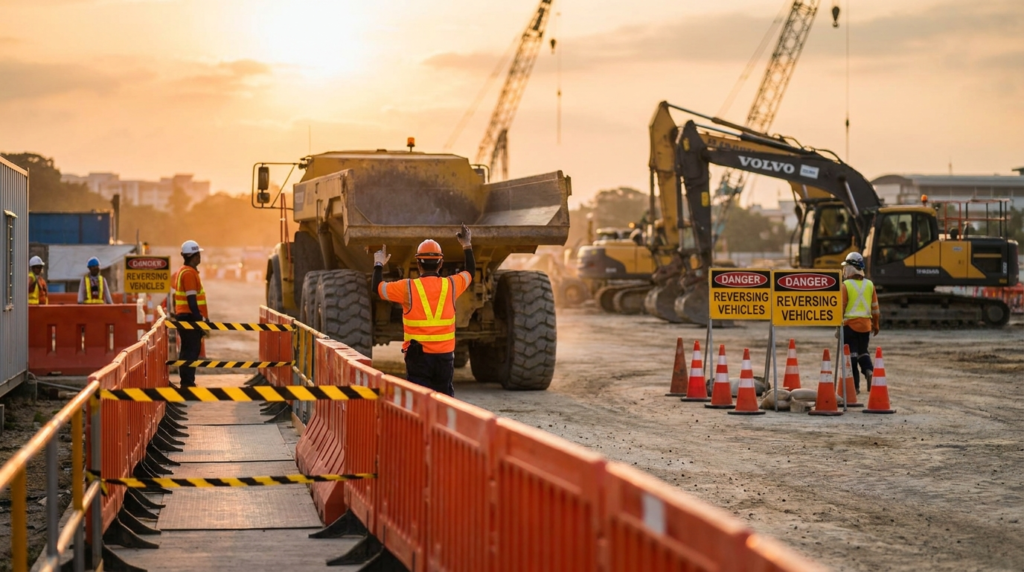
The mechanics are almost always the same. A driver reverses a truck, forklift, or excavator across a yard or site access route. A worker on foot — often a banksman, sometimes a passer-by — is standing in a zone the driver cannot see through mirrors or cameras alone. There is no barrier, no clearly marked exclusion zone, and no signage forceful enough to make either party stop and reassess. The WSH Council’s vehicular safety advisory, published in June 2026, was written directly in response to four banksman fatalities recorded between 2022 and 2025, and it sets out seven specific risk controls employers are now expected to implement.
What the New Advisory Actually Asks For
The seven controls cover ground rules most Singapore worksites already know in theory: designated pedestrian walkways separated from vehicle paths, clearly demarcated reversing and blind-spot zones, mandatory banksman positioning with high-visibility signalling, and posted traffic management plans at every site entrance. What trips employers up in practice is execution — a reversing zone that’s marked on a drawing but not on the ground, a “Banksman Required” sign that’s faded or hidden behind stacked materials, or a traffic management plan that exists as a PDF nobody on-site has actually seen. WSH inspectors have been explicit that during site checks, they are now looking for physical, weatherproof signage that matches the traffic management plan on file — not just the paperwork.
The Cheapest Control Is Also the Most Overlooked
Compared to installing proximity sensors, retrofitting reversing cameras, or running vehicular safety workshops, correct signage is inexpensive and can be actioned in days rather than months. SS 508-compliant reversing warning signs, vehicle exclusion zone markers, banksman position signs, and pedestrian segregation signage give both drivers and workers on foot an unambiguous, standardised visual cue — the same pictogram, in the same place, every time, regardless of who’s on shift. For a site that’s already relying on verbal briefings and tribal knowledge to manage vehicle movement, a proper signage audit against the WSH Council’s seven controls is often the fastest way to close the gap before the next inspection, and before the next incident.
Getting Ahead of the Next Site Inspection
With workplace traffic fatalities already ahead of last year’s pace, MOM and the WSH Council are unlikely to ease up on enforcement for the rest of 2026. Employers running any site with vehicle movement — construction, logistics, warehousing, platform delivery hubs — should treat this as the moment to walk the site with the seven-control checklist in hand and check that every reversing zone, pedestrian route, and banksman post is marked the way the traffic management plan says it should be.
The data is blunt: Singapore’s worksites are losing more people to reversing vehicles and blind spots than to almost any other single hazard, and the regulatory response is only getting stricter. Fixing the signage gap won’t solve every root cause, but it is the fastest, most affordable step most sites can take this week. Browse our full range of SS 508-compliant safety signs at safetysigns.sg.