CONSTRUCTION
On 14 May 2026, a 23-year-old banksman died at the future Turf City MRT site after stepping into an excavator’s own work zone to guide a lift — the fifth such death since 2022. The Workplace Safety and Health Council’s response, issued a month later, wasn’t a call for closer supervision. It was a demand for better-marked ground.
A Death That Fit a Five-Year Pattern
The incident itself was brief and, by now, familiar. During excavation works at the future Turf City MRT station in Bukit Timah, a worker assigned banksman duties entered the zone where an excavator was removing a concrete section beneath a deck, and was struck and killed by the falling slab. It was the kind of accident that reads, on paper, as a single tragic lapse. The Workplace Safety and Health Council didn’t treat it that way. Its advisory of 12 June 2026 placed the Turf City death alongside four earlier fatalities involving banksmen and traffic controllers between 2022 and 2025 — five deaths in the same role, doing the same job of standing close to moving plant to keep everyone else safe.
Seven Controls, and Why Demarcation Comes Second
The Council’s response was a seven-control advisory covering vehicular and mobile plant safety on worksites, and danger zone demarcation sits at control number two — directly behind the requirement for a documented traffic management plan. Demarcation, in practice, means physically and visually marking the boundary of the space a piece of mobile plant needs to operate safely, so that anyone approaching — a banksman included — can see, without having to be told twice, exactly where “clear” ends and “danger zone” begins. It sounds close to obvious. MOM’s own inspection data over the past five years shows it is routinely missing.
The Pattern Behind Singapore’s Worksite Vehicle Deaths
Banksman fatalities are the sharpest edge of a much broader problem. “Struck by moving vehicles, including forklifts” has stayed among the top causes of fatal and major workplace injuries in Singapore for five consecutive years, and vehicular incidents were again the single leading cause of workplace death in the first half of 2026, responsible for nine of the year’s 21 fatalities. The common thread investigators keep finding is strikingly consistent: a pedestrian worker struck by a reversing or turning vehicle, on a site with no designated walkway, no mirrors at blind corners, and no traffic management plan separating foot traffic from vehicle routes in the first place. Demarcation isn’t a paperwork fix for that pattern — it’s the physical version of the same control.
Why the Banksman Is Often the One Most at Risk
There’s a particular irony in where this risk concentrates. The banksman’s entire job is to stand close enough to a reversing vehicle or an active excavator to direct it safely — which means the zone that needs to be clearest for everyone else’s benefit is precisely the zone the banksman has to enter. If that boundary exists only in a method statement and not on the ground, the person whose job is to manage the danger zone has no reliable way to know, moment to moment, whether they’ve stepped inside the machine’s own space rather than the safe edge of it. Clear demarcation protects pedestrians walking past a worksite. It’s arguably even more critical for the one person whose job requires them to work the line.
What Site Operators Should Check This Week
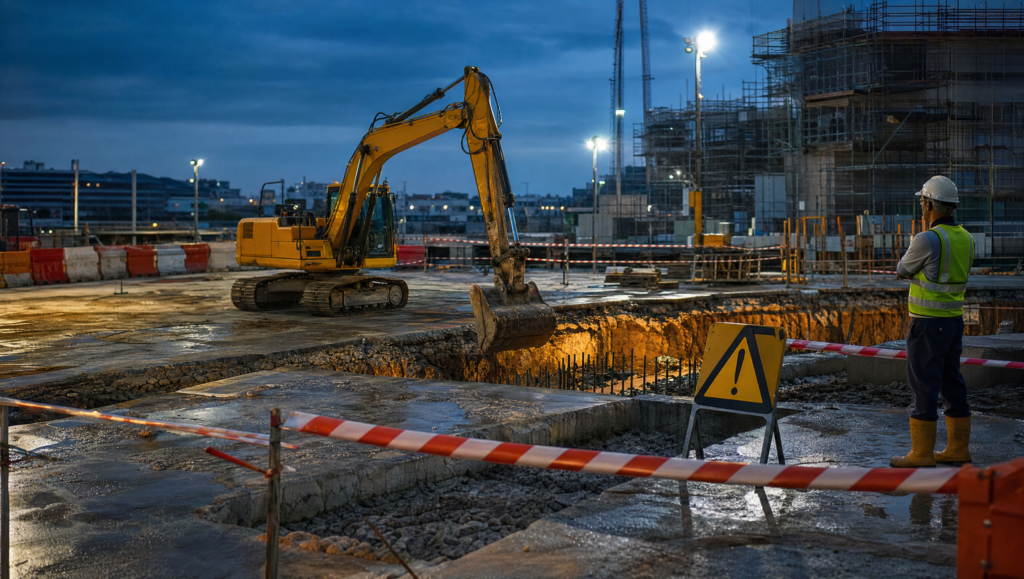
None of the seven controls in the WSH Council’s advisory require new legislation to act on — they can be implemented on any site this week. That starts with physical exclusion barriers and high-visibility “Danger — Keep Clear” signage around every piece of mobile plant in operation, not just at the site perimeter; pedestrian-vehicle segregation signage at every access point where foot and vehicle traffic cross; convex mirror signage at blind corners on internal haul roads; and a traffic management plan that reflects the site’s actual layout that day, not a generic template filed once at project start. For sites running excavators, cranes or any reversing heavy plant, the danger zone should be demarcated freshly each time the plant’s working radius changes — because the whole point of control two is that “clear” is only useful if it’s visible, not assumed.
Conclusion
Five banksman and traffic controller deaths since 2022, one as recent as May this year, is the WSH Council’s evidence that supervision and training alone haven’t closed this gap — the ground itself has to do part of the job. Danger zone demarcation and pedestrian-vehicle segregation signage are inexpensive relative to what they’re meant to prevent, and unlike a briefing, they don’t rely on anyone remembering where the line was. Browse our full range of SS 508-compliant safety signs at safetysigns.sg, including danger zone, vehicle warning and pedestrian segregation signage built for active construction and logistics sites.
Author: safetysigns.sg Team
Date: September 13, 2026