WORKPLACE SAFETY
When something goes wrong on a worksite, nobody reads the safety manual. Workers run — and where they run, and how fast help arrives, is decided by signage most companies put up years ago and never think about again. MOM has now named emergency response as one of three areas every workplace must get right.
When the Ministry of Manpower announced its enhanced enforcement measures on 26 June, most of the attention went to the numbers: composition fines up from S$2,000 to S$3,000, stop-work orders extended from five weeks to a minimum of eight, and a three-month hiring debarment for the worst cases. But buried in the same statement was a quieter instruction that deserves just as much attention. MOM told employers to pay particular attention to three things: vehicle-related activities, individual worker lapses — and emergency response procedures, so that appropriate rescue or medical assistance can be provided promptly after an accident.
That last item is the one most workplaces have never actually tested. Twenty-one workers have died on the job in Singapore so far in 2026, up from eighteen at the same point last year. Seven of those deaths came in a single four-week stretch across five separate incidents. In several of the cases that prompted MOM’s intervention, the question was not only why the accident happened, but what happened in the minutes immediately after.
Emergency Response Is a Wayfinding Problem
Strip away the paperwork and an emergency response plan is mostly a set of movements: the injured worker’s colleagues must reach a first aid box or trained first aider, someone must fetch the AED, everyone else must clear the area and gather where they can be counted, and arriving paramedics must find their way in. Every one of those movements depends on signage. A first aid station that only the safety officer can locate is, in the first five minutes, a first aid station that does not exist.
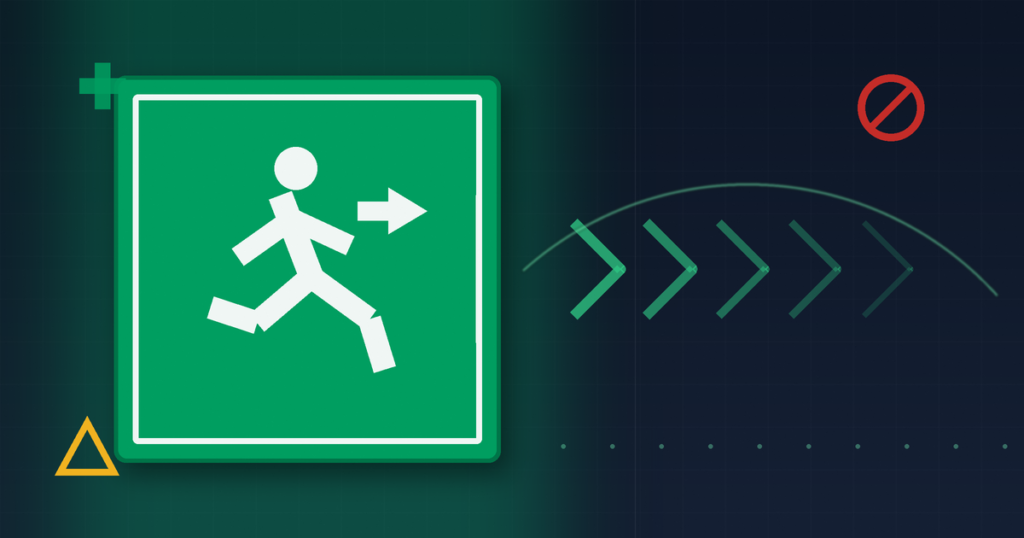
This is exactly what SS 508’s green-and-white “safe condition” signs are for. Green is the one colour in the standard that never warns and never prohibits — it only ever points to safety: first aid points, emergency exits, assembly points, eye-wash stations, emergency showers, AED locations. Where prohibition and warning signs work by stopping behaviour, safe condition signs work by directing it, which means they must be visible from the places where accidents actually happen — not tucked behind a roller shutter or faded to grey on a sun-facing hoarding.
The Walk-Through That Takes Twenty Minutes
Here is a test any supervisor can run before this week is out. Stand at the three highest-risk points on your site — the vehicle route, the height-work zone, the machine line. From each one, ask four questions. Can I see the way to the nearest first aid point without asking anyone? Is the assembly point signed at the point itself, not just on the evacuation diagram in the site office? Would a subcontractor’s worker, on site for the first day, find the emergency exit if the lights failed? And could an ambulance crew who have never visited locate the gate and the casualty without a phone call?
Every “no” is a gap in your emergency response procedure — the precise area MOM has said inspectors and investigators will be looking at. And unlike retraining programmes or process redesign, these gaps close fast: a green SS 508-compliant first aid sign, an assembly point sign at eye level, a photoluminescent exit sign that stays visible in a blackout. Most cost less than the coffee run for your next toolbox meeting.
The Enforcement Window Has Not Closed
The nationwide Safety Time-Out that MOM called on 26 June has run its two weeks, but the enhanced enforcement measures remain in force until 31 July — and MOM has been explicit that they will be extended if safety outcomes do not improve. That means every inspection between now and the end of the month carries the higher S$3,000 first-offence fine and the eight-week stop-work order behind it. Singapore ended 2025 with a record-low fatality rate of 0.96 per 100,000 workers; 2026 is currently tracking the wrong way, and the regulator has said plainly that it intends to bend the curve back.
The companies that come through this period well will be the ones that treated the Time-Out as a starting point rather than a pause. Emergency response is the cheapest of MOM’s three focus areas to fix, and the one where signage does most of the work. Walk your site this week, count the “no” answers, and close them. Browse our full range of SS 508-compliant safety signs — including first aid, assembly point, and emergency exit signs — at safetysigns.sg.
— safetysigns.sg Team, 13 July 2026