WORKPLACE SAFETY
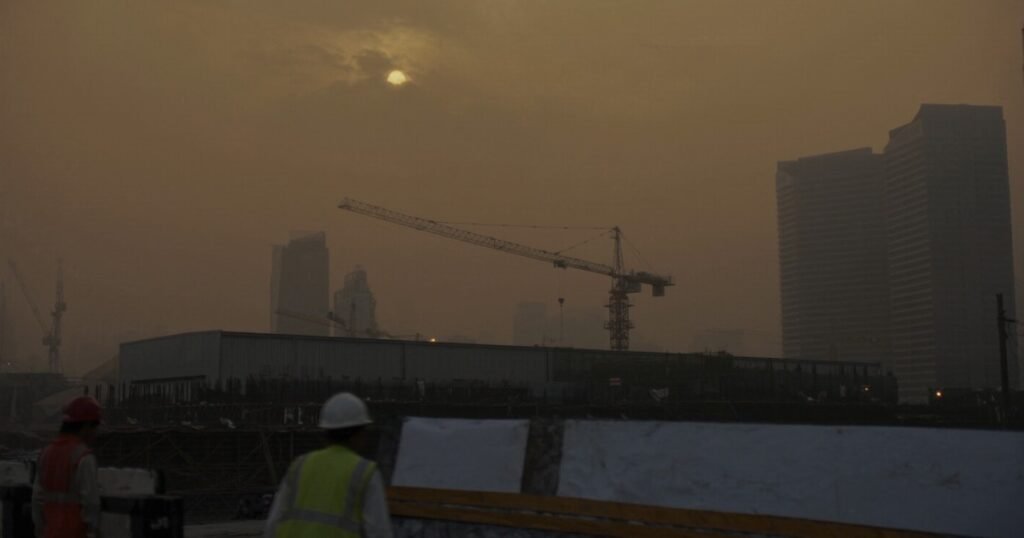
On 4 September 2026, Singapore’s 24-hour PSI crossed into unhealthy territory for the first time since October 2023. For the delivery riders, construction crews, port workers and cleaners who can’t simply stay indoors, that single number changes the shape of the workday — and most sites still don’t have the signage or protocols to match.
A Three-Year Warning Sign Just Reappeared
For nearly three years, Singapore’s air quality stayed comfortably out of the headlines. That streak ended on 4 September 2026, when the 24-hour Pollutant Standards Index climbed above 100 in central Singapore — officially “unhealthy” — for the first time since 8 October 2023. The National Environment Agency traced the smoke to dry-season hotspots and plumes drifting over Sumatra and Kalimantan, and Singapore’s Haze Task Force moved quickly to activate its advisories. For office workers, the change is an inconvenience. For the tens of thousands of people whose jobs keep them outdoors — construction crews, port and shipyard workers, cleaners, security officers, and delivery riders who never clock in at a fixed address — it is an immediate operational problem.
What MOM’s Tripartite Advisory Actually Requires
The Ministry of Manpower, together with NTUC and the Singapore National Employers Federation, has a standing tripartite advisory on haze-related workplace measures, and it is not vague guidance. Employers are told to reduce or defer prolonged and strenuous outdoor work, rotate workers through indoor rest breaks, keep hydration accessible, and provide properly fit-tested respiratory protection where outdoor work cannot be avoided. Crucially, if an employer suspends outdoor operations on an ad hoc basis because of haze, the cost sits with the employer — not with workers’ pay or leave. MOM has also been explicit that this sits under the Workplace Safety and Health Act: sites that fail to manage haze-related risk can face enforcement action, including stop-work orders and composition fines, the same tools used after physical safety lapses.
The Signage Gap Most Sites Overlook
Here is where most Singapore worksites fall short, and it has nothing to do with having enough N95 masks in the store room. WSH obligations are only as good as how clearly they’re communicated on the ground, and haze response is a fast-moving, day-by-day decision — which means it needs the same visual infrastructure as any other site hazard. A muster point sign tells workers where to go in a fire. A confined space sign tells them where extra precaution is required. But most sites have no equivalent for haze: no posted PSI/PM2.5 reference point near the site office, no signage marking designated indoor rest and hydration areas, no reminder at entry points about correct N95 fit before strenuous outdoor tasks resume. Without that signage, the advisory lives in an HR memo nobody reads mid-shift, and supervisors end up relying on memory during exactly the kind of chaotic, fast-changing conditions where mistakes happen.
Getting Ahead of the Next Haze Episode
Regional haze is now a recurring feature of Singapore’s third and fourth quarters, not a one-off event, and MOM’s enforcement posture on workplace safety has only tightened in 2026. The practical fix is straightforward: treat haze readiness the same way you’d treat any other WSH control. Post the site’s haze response plan at entry points. Mark designated indoor rest and rehydration areas with clear, durable signage. Put a visible reminder at PPE stations about correct respirator fit-testing. None of this replaces an employer’s duty to monitor the PSI and adjust work assignments — but it closes the gap between what the advisory says on paper and what a worker actually sees and acts on mid-shift.
Conclusion
Singapore’s haze-free run lasted almost three years, and it just ended on a Friday in September. The sites that treat this as a recurring operational risk — with the same clear, compliant signage they’d use for any other hazard — will be the ones that pass MOM’s next inspection without a scramble. Browse our full range of SS 508-compliant safety signs at safetysigns.sg.
Author: safetysigns.sg Team
Date: September 8, 2026