WORKPLACE SAFETY
On the morning of 22 September, a work platform carrying two stevedores came loose from its crane at Tuas Port and dropped into the sea. Both men later died. MOM’s response was unusually blunt for a ministry statement — lifting gear “especially if used to lift people” has to be inspected properly, and operators have to follow their instructions to the letter — and it points straight back to a category of signage many sites treat as an afterthought.
A Routine Lift That Wasn’t
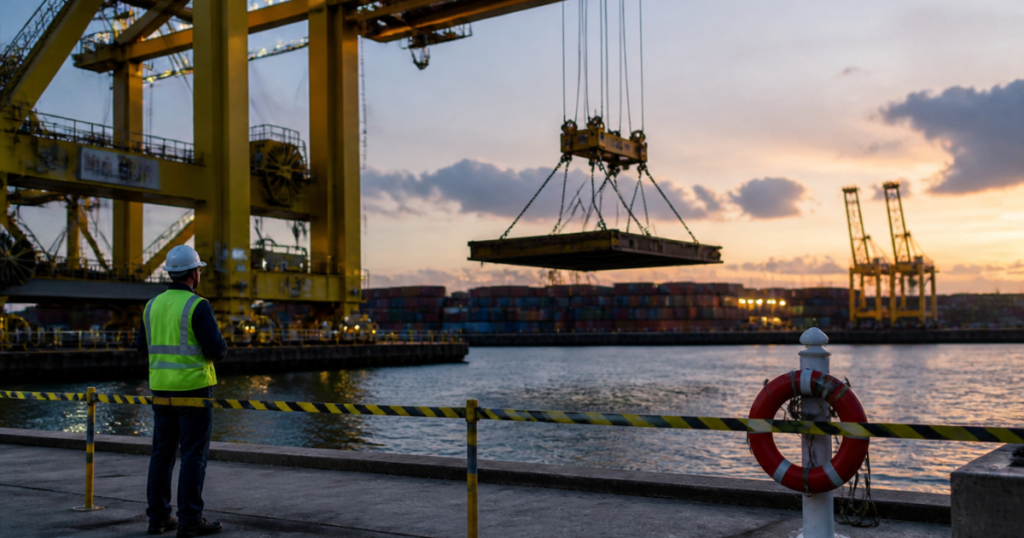
At around 8:40am on 22 September, two workers were carrying out stevedoring operations — loading and securing cargo — from a platform suspended by crane at Tuas Port, operated by PSA Corporation. The platform came away from the crane and fell into the water with both men on it. SCDF paramedics pronounced a 44-year-old dead at the scene; a 33-year-old colleague was pulled from the sea and rushed to Ng Teng Fong General Hospital, where he later died. PSA said it is “working closely with the relevant authorities” and supporting the men’s families. The Ministry of Manpower is investigating, and issued a statement that named the failure point directly: lifting equipment and gear “have to be properly maintained and inspected before use, especially if they are used to lift people,” and operators “have to comply strictly to operating instructions.”
Why MOM Went Straight to Equipment, Not the Water
It would have been easy for MOM’s statement to lead with water safety — lifejackets, rescue readiness, man-overboard drills. It didn’t. It led with the lift itself, because under the Workplace Safety and Health (Operation of Cranes) Regulations, using a crane to move people is a distinct, higher-risk category of lifting operation from moving cargo, with its own inspection, certification and operating-procedure obligations. A platform built or rigged to carry goods doesn’t become safe to carry people just because it’s convenient that day. MOM’s phrasing — “especially if they are used to lift people” — reads as a pointed reminder that man-riding lifts sit under a stricter standard than routine cargo lifts, and that standard lives or dies on whether the equipment was actually inspected and the operator actually followed the lifting plan, not on whether a platform looked sturdy enough on the day.
The Signage a Lifting Operation Actually Needs
This is where site signage stops being background and becomes the paper-and-plastic evidence of exactly the compliance MOM is now investigating. A compliant lifting operation depends on several categories of SS 508-compliant signage working together: safe-working-load (SWL) and certification tags fixed to the equipment itself, so anyone can see at a glance whether a load test is current; exclusion-zone and “no entry — lifting operation in progress” signage marking the ground or deck beneath a suspended load, so no one stands where a failure would put them; and, for any work conducted over or near water, mandatory life-jacket signage and life-buoy-location markers showing where rescue equipment actually is, not just that it exists somewhere on site. None of these signs prevent a rigging failure on their own. What they do is make the state of the equipment and the boundaries of the danger zone visible to everyone on site — including, when an incident does happen, to the investigators trying to reconstruct exactly what broke down.
Ports and Marine Worksites Are a Signage Blind Spot
Singapore’s safety conversation over the past year has understandably centred on construction and manufacturing — scaffolding, machine guarding, confined spaces. Marine and port operations get comparatively little of that attention, even though MOM’s own first-half 2026 figures show drowning and suffocation accounted for five of the year’s 21 workplace deaths, including three crew members lost in a supply boat collision in June. That’s a quarter of this year’s fatalities in a category most signage audits don’t even check, because “safety signs” still conjures hard hats and hi-vis vests before it conjures a crane’s SWL tag or a life-buoy marker on a quay. For operators running lifting equipment near water — ports, shipyards, offshore support work — the practical takeaway is to treat lifting-gear certification signage and over-water rescue signage as core categories to audit, not edge cases to add later.
What This Means Before the Next Lift
Nothing in MOM’s statement suggests this was a one-off freak failure; it suggests a system that’s supposed to catch a compromised platform before it goes over water, and didn’t, this time. Any site running crane-suspended platforms — for cargo or for people — should be able to answer three questions today: is the current load-test certificate visibly posted on the equipment, is the exclusion zone beneath every suspended load physically marked, and is the rescue equipment for anyone working over water signed and located where a worker under pressure could find it in seconds. Those are inspection and signage questions, and they’re answerable this week, well ahead of whatever MOM’s investigation ultimately finds. For the full picture of what SS 508 requires across every sign category, see our complete guide to SS 508 signage. Browse our full range of SS 508-compliant safety signs at safetysigns.sg.
Author: safetysigns.sg Team
Date: 25 September 2026