WORKPLACE SAFETY
Somewhere in Singapore this week, an inspector will step onto a worksite unannounced. Before a single document is requested or a single worker interviewed, the site has already made its first statement — through what is posted at the gate, on the hoarding, and beside every hazard. With enhanced enforcement running until 31 July and first-offence fines now at $3,000, that first statement has never mattered more.
The Most Expensive Month to Be Caught Unprepared
Since 26 June, the Ministry of Manpower has been inspecting workplaces under its toughest posture in years. The trigger was grim: seven workers killed in five incidents over four weeks, pushing 2026’s fatality count to 21 — up from 18 at the same point last year, and a sharp reversal from 2025’s record-low fatality rate of 0.96 per 100,000 workers. MOM’s response, in force until at least 31 July, raised composition fines for first-time offences found during inspections from $2,000 to $3,000, stretched the minimum Stop-Work Order from five weeks to eight, and added a three-month bar on hiring new migrant workers for the most egregious cases. The nationwide voluntary Safety Time-Out that accompanied these measures winds down around 10 July — which means the coming weeks are when inspectors check whether anything actually changed.
What an Inspector Reads Before Anyone Says a Word
Experienced WSH officers will tell you that a site announces its safety culture visually, within the first two minutes. Is the hoarding signage complete and legible, or sun-bleached and peeling? Does the confined space entrance carry a proper danger sign, or a laminated A4 printout curling at the corners? Are PPE requirements posted where workers actually enter the zone, or on a noticeboard nobody passes? None of these observations is the formal basis of an inspection — that comes from risk assessments, permits and interviews — but they shape everything that follows. A site whose signage is current, compliant and positioned at the point of hazard signals a management team that walks the ground. A site with missing or improvised signs invites the inspector to dig deeper, because visible corner-cutting rarely travels alone.
Signage Lapses Are Compliance Lapses
Under the Workplace Safety and Health Act, the duty to warn is not decorative. Employers and occupiers must take reasonably practicable measures to protect workers, and the regulations made under the Act repeatedly require hazards to be communicated — danger signs at excavations and confined spaces, warning notices for machinery, mandatory PPE instructions where risk assessments demand protection, and fire safety signage that SCDF expects to match SS 508 shapes and colours. An absent or wrong sign is therefore not a housekeeping issue; it can form part of the factual basis for a composition fine, and during this enforcement window that fine starts at $3,000 per offence. Set against the cost of a compliant aluminium sign — a rounding error on any project budget — the asymmetry is hard to overstate. An eight-week Stop-Work Order on even a small project costs more than a lifetime supply of signage.
The Six Categories Every Site Should Walk-Test This Week
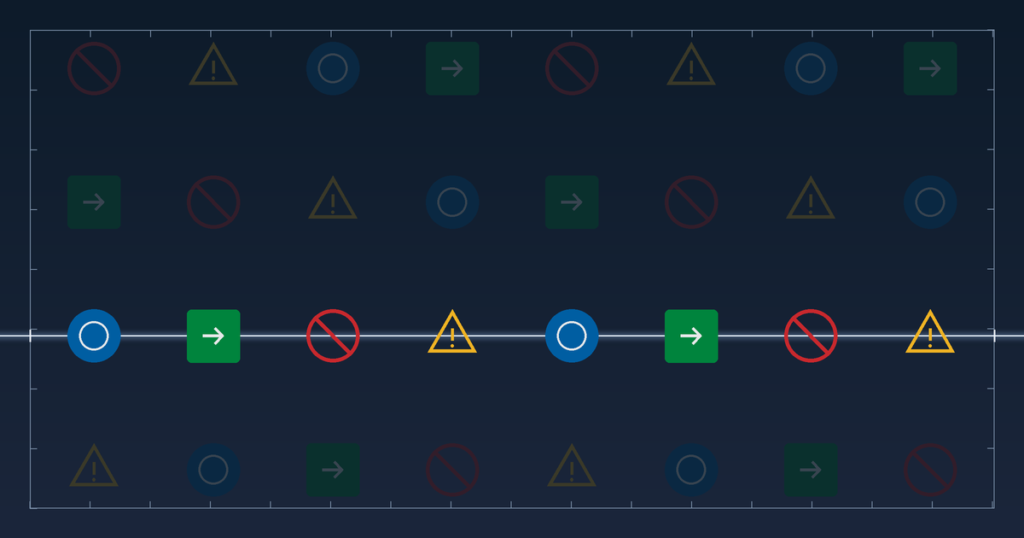
A practical self-audit takes one walkthrough with the site plan in hand. Check your prohibition layer first: no smoking, no entry and no unauthorised access signs at every controlled boundary, in the red circle-and-bar format SS 508 prescribes. Then the warning layer: amber triangles for overhead loads, forklift traffic, electrical rooms and excavation edges, placed at the approach — not at the hazard itself, where the warning arrives too late. Then mandatory signs: blue circles for helmets, harnesses, eye and ear protection at each zone entrance. Then fire safety: extinguisher, hose reel and fire equipment location signs that remain visible across an obstructed floor. Then safe-condition signage: green exit routes, assembly points and first aid stations that a disoriented worker can follow under stress. Finally, the work-in-progress and hoarding signage that the public and the Building and Construction Authority see from the street. If any sign fails the three tests — right symbol, right position, still legible — replace it before the inspector applies the same tests for you.
After 31 July, the Standard Doesn’t Drop
MOM has said plainly that the enhanced measures may be extended if fatality numbers do not improve, and the underlying duties exist regardless of the enforcement posture of the month. Sites that use this window to bring their visual safety layer up to standard are not just avoiding a $3,000 fine in July — they are fixing the communication layer that keeps new workers, subcontractors and visitors safe long after the inspection blitz ends. The inspector’s first two minutes on your site are simply a preview of a new worker’s first two minutes. Both deserve signs that are complete, compliant and impossible to miss. Browse our full range of SS 508-compliant safety signs at safetysigns.sg.
— safetysigns.sg Team, 6 July 2026