WORKPLACE SAFETY
Sometime in the past year, Singapore’s official records stopped calling it “noise-induced deafness” and started calling it “noise-induced hearing loss” — a small wording change with a large implication. The condition it describes now accounts for 57% of every occupational disease diagnosed in Singapore so far this year, more than any other illness on the books, and most of the workplaces producing it have no marked way of telling a worker they’ve already walked into the danger zone.
A Name Change That Admits the Real Problem
For years, Singapore’s occupational health statistics filed this condition under “noise-induced deafness” — a label that suggested an endpoint, something that had already happened and couldn’t be undone. The 2026 shift to “noise-induced hearing loss” is more than semantic housekeeping. Deafness implies a binary state; hearing loss describes a spectrum, and a progressive one. A worker doesn’t wake up deaf after one shift on a punch press — their threshold creeps outward in fractions of a decibel, shift after shift, often for years before a scheduled audiometric test catches it. The renaming lines up Singapore’s terminology with how the disease actually behaves: cumulative, largely silent until the damage is already done, and — critically — preventable at almost every point along the way if the exposure is controlled early.
The Numbers Behind the New Name
The scale is what makes the wording matter. MOM’s first-half 2026 data shows occupational disease cases climbing to 620, up from 485 over the same period last year, and noise-induced hearing loss accounts for 57% of them — by far the single largest category, ahead of musculoskeletal disorders. Manufacturing remains the sector driving most of it, and within manufacturing, metalworking is the clearest offender: seven out of every ten metalworking workplaces inspected expose employees to noise at or above 90 decibels A-weighted, well past the level where hearing damage begins to accumulate. Grinding, punching, shearing, forming and stamping — the ordinary vocabulary of a metalworking floor — are also, functionally, a list of the loudest tasks in the country’s industrial economy. None of it announces itself the way a fall or a struck-by incident does. That’s precisely why the case count keeps climbing while the injury headlines go elsewhere.
What the Law Already Requires
Singapore isn’t short on rules here — the Workplace Safety and Health (Noise) Regulations 2011 cap exposure at 85 dB(A) averaged over an eight-hour shift, with an absolute ceiling of 87 dB(A), and require any employer running a workplace above that threshold to implement a full Hearing Conservation Programme. That means noise monitoring records, suitable hearing protectors issued to exposed workers, and audiometric examinations before a worker starts noise-exposed work and every year after, reviewed under a Designated Workplace Doctor. A confirmed diagnosis has to be reported to MOM by both employer and doctor within 10 days via iReport, and the penalties for skipping the programme entirely reach $50,000 for an individual and $200,000 for a company. The framework is detailed and has been in force for over a decade. What trips employers up in practice isn’t ignorance of the regulation — it’s translating “85 dB(A) averaged over eight hours” into something a worker on the floor can actually act on in the three seconds before they walk past a press.
Where the Compliance Gap Actually Sits
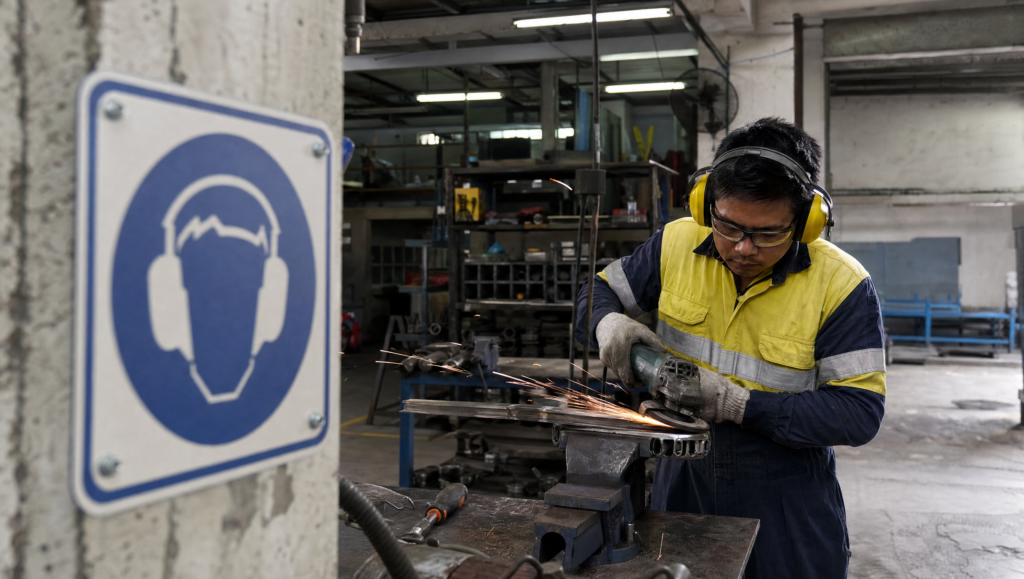
This is the part of a Hearing Conservation Programme that inspectors can verify at a glance, and the part most sites get wrong: whether the noise hazard zone is physically marked. A decibel reading in a monitoring log doesn’t protect anyone standing on the floor — a mandatory ear protection sign posted at the entrance to a 90 dB(A) zone does, because it converts a number in a compliance file into an instruction a worker sees before they need hearing protectors, not after an audiometric test flags a problem. SS 508 and ISO 7010 both specify exactly what that signage should look like — the blue mandatory-action pictogram for hearing protection, positioned at the boundary of the measured zone, not buried in a briefing slide from six months ago. When MOM inspectors walk a metalworking floor, a Hearing Conservation Programme that exists only on paper is a much harder pass than one a worker can point to on the wall.
The Fix Costs Less Than the Fine
None of this requires re-engineering a production line. It requires knowing where the 85 dB(A) boundary actually falls on your floor — most Hearing Conservation Programmes already have that data from the mandatory monitoring — and putting a compliant mandatory ear protection sign at every point a worker crosses it, alongside clear signage at PPE storage points so hearing protectors are as visible as the hazard itself. For a mid-sized metalworking shop, that’s a handful of signs against a $200,000 corporate exposure and, more importantly, against a worker’s hearing that doesn’t come back once it’s gone. Given how the 2026 numbers are trending, “we have a Hearing Conservation Programme” is no longer going to be a satisfying answer if nobody on the floor can show where its boundaries are.
Conclusion
Singapore just renamed this condition to reflect what it actually is: gradual, cumulative, and stoppable before it becomes permanent. Marking the noise zones a worker walks through every shift is one of the cheapest, fastest ways to act on that. Browse our full range of SS 508-compliant safety signs at safetysigns.sg.
Author: safetysigns.sg Team
Date: September 14, 2026