On 12 June 2026, the Workplace Safety and Health Council published an advisory most office workers never heard of and most site supervisors can’t afford to ignore. It set out seven controls for protecting banksmen and traffic controllers, the workers whose entire job is standing near moving machinery so nobody else has to. The advisory arrived after a grim run of numbers: vehicular incidents were the single leading cause of workplace deaths in Singapore in 2025, responsible for 15 of the year’s 36 fatalities, and four banksmen and traffic controllers had already died between 2022 and 2025. Then, in May 2026, a fifth case landed on the same list — a worker directing an excavator was struck by a falling concrete slab while standing inside the machine’s own work zone.
Nationally, the picture has not improved. Singapore has recorded 21 workplace fatalities so far in 2026, up from 18 over the same period last year, prompting the Ministry of Manpower to call a nationwide voluntary Safety Time-Out at the end of June and to raise fines and lengthen Stop-Work Orders for serious lapses. Against that backdrop, WSH Council’s advisory is not paperwork. It is a direct response to a pattern of deaths that keeps repeating in the same few ways.
What “demarcation” actually means on a live site
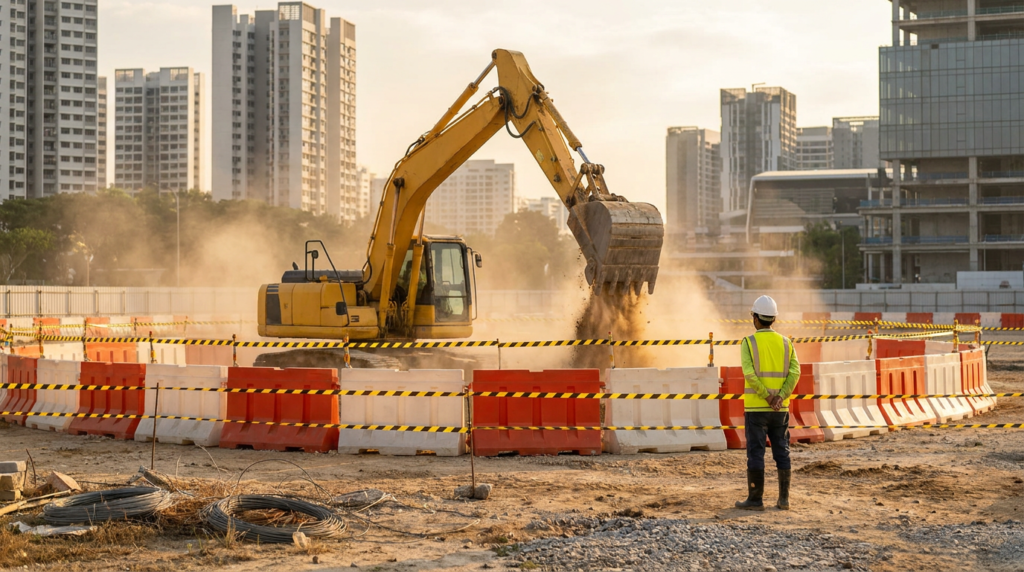
Danger zone demarcation is control number two of the seven WSH Council named, and it is worth being precise about what it requires, because the word “demarcation” gets used loosely. It means marking an exclusion area around operating plant or a moving vehicle — bounded by everywhere that machine can physically reach — and keeping people out of it entirely, not just warning them it’s there. For an excavator, that is the full slew arc the cab and counterweight sweep through, not just the bucket end. For a crane, it is the load’s radius as it travels between pick and set, which moves as the load moves. For a reversing vehicle, it is the blind space directly behind it, the zone a banksman has to control from outside, never from within.
The May 2026 incident is the one WSH Council keeps returning to in its guidance, because it illustrates exactly how a demarcation fails. The zone either didn’t exist in a form that mattered, or it existed only as an idea rather than a physical barrier. A person standing under a machine’s working envelope is not protected by having been told where the envelope is.
Barriers first, signage and markings to reinforce
This is the part of the advisory that lands directly on signage and site marking decisions, and it is worth quoting the logic rather than paraphrasing it away. Paint indicates a boundary. It does not enforce one. WSH Council’s advisory calls for physical barriers to separate work zones first, with floor markings and signage layered on top to reinforce what the barrier already does, and high-visibility gear as a last line of defence. Signage on its own, without a barrier behind it, is a zone that exists only in the mind of whoever happened to read the sign that day.
That sequencing matters for anyone responsible for procuring site safety equipment. A warning sign at the edge of an excavator’s work area is doing its job when it’s backed by a physical barrier a worker would have to consciously step over or around. It is doing very little on its own. Singapore Standard SS 508 governs the shape, colour, and pictogram of the sign itself, but SS 508 compliance was never meant to be the whole system — it is one layer in a stack that starts with a barrier and ends with a worker who has been trained to hold position outside the line.
What this means for employers this week
For facility managers, contractors, and WSH officers, the practical task is straightforward even if the compliance stakes are not. Walk the site and identify every piece of live plant — excavators, cranes, reversing vehicles, forklifts — and check whether the zone around each one is a physical barrier or just a painted line. Where it’s only paint, that is now a gap worth closing before the next audit, not after an incident. Lifting plans should already show the zone of operation as a sketch, per WSH Council’s guidelines on lifting plan development, and that same discipline is worth extending to any fixed reversing point, such as a loading bay a lorry backs into daily. A fixed hazard deserves fixed demarcation, not a banksman standing in for a barrier that was never installed.
Getting this right is also, increasingly, about how a business is judged from the outside. Enforcement measures introduced alongside the Safety Time-Out — higher fines, longer Stop-Work Orders, and hiring bans for the most serious lapses — are still in effect, and MOM has said they may be extended if outcomes don’t improve. A site with clearly barriered, correctly signed exclusion zones is not just safer. It is easier to defend at inspection.
The zone that matters is the one with nobody in it
WSH Council put demarcation second among its seven controls for a simple reason: it removes the person from the danger rather than asking them to be careful inside it. The excavator’s slew arc, the crane’s load path, and the space behind a reversing lorry are the same hazard in different clothes, and each one is only as safe as the barrier and signage combination protecting it. Browse our full range of SS 508-compliant safety signs at safetysigns.sg.